




Design by Committee Isn't a Taste Problem. It's an Ownership Problem.
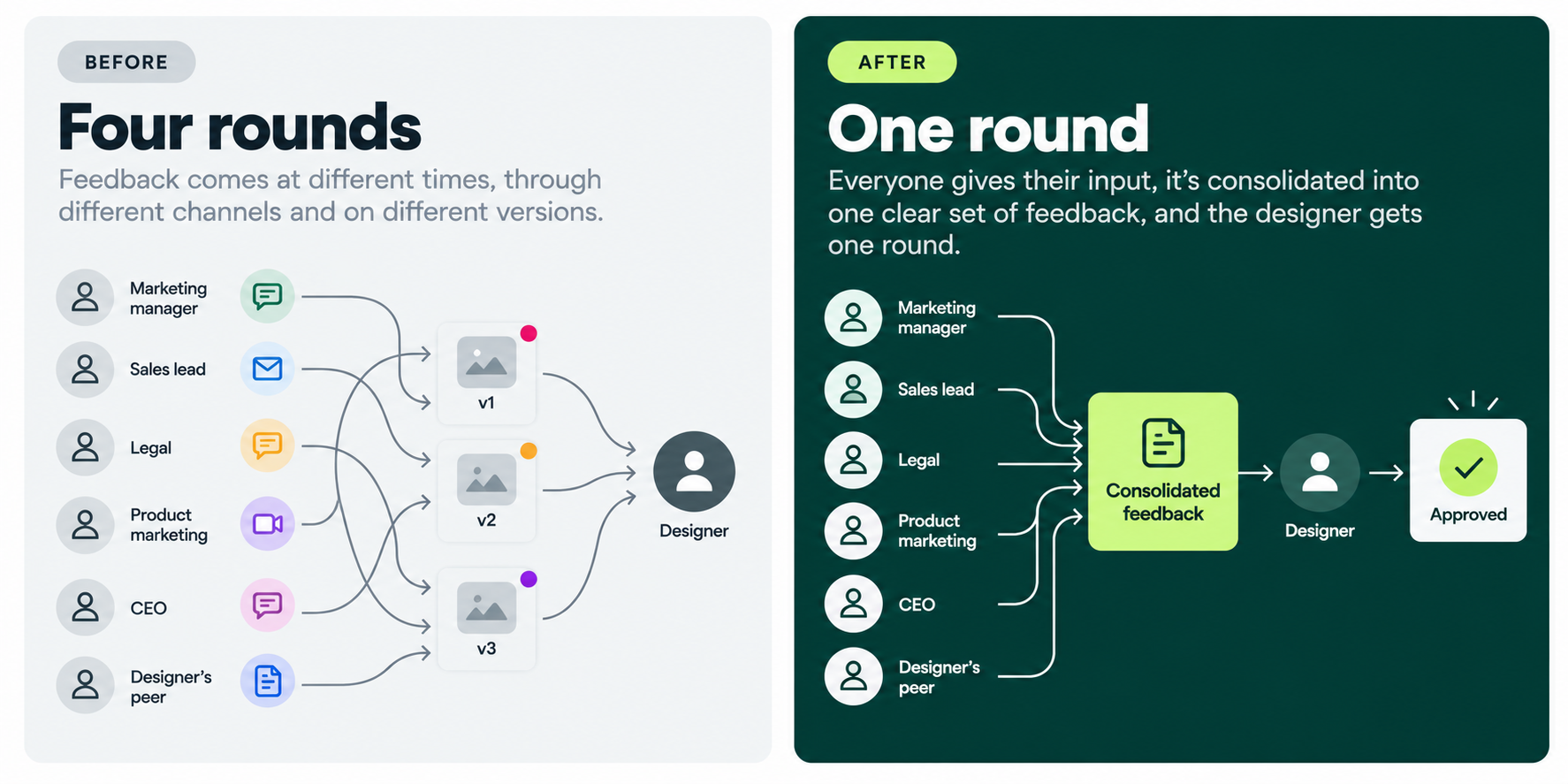
Six people review the banner. Sales wants the offer bigger. The CEO wants more white space. Legal flags a claim. Product marketing rewrites the headline. The designer gets it all at once, half of it contradictory, and two weeks later the team ships something nobody likes.
That's design by committee, and it's usually blamed on too many opinions. At Bespire, our Success Managers sit in the middle of client approval loops every day, and what we see is different: committees form where nobody owns the decision, not where people have opinions. The fix isn't fewer voices. It's deciding in advance what each voice is for.
The Aztek story, and why it's the wrong lesson for marketing teams
Every article on design by committee tells the story of the Pontiac Aztek: a crossover shaped by committees and focus groups that became a byword for compromise. GM reportedly needed around 30,000 sales a year to break even; its best year fell short of 28,000.
The usual lesson is "have a single decision maker." Fine for a car company with a design chief. Not so useful for a marketing team where the CEO, sales and legal all have a legitimate stake in what goes out. You can't just remove them. And most teams have never written down who decides what: in Atlassian's State of Teams 2025 survey, only 20% of knowledge workers said their organization has effective processes for communicating decisions across teams.
So the better lesson is this: approvals are a system you design, not a personality problem you avoid.
Input vs approval: the distinction that dissolves most committees
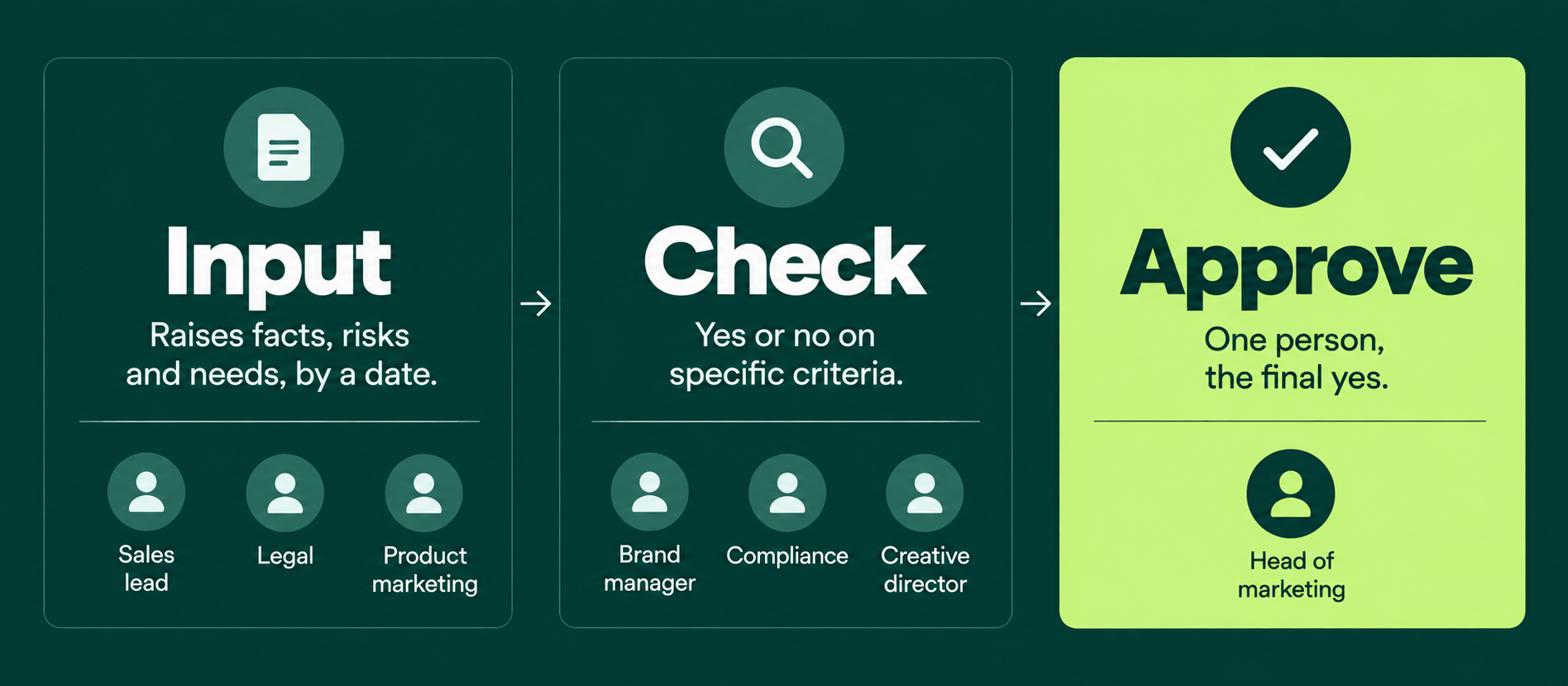
Most committees are really three different jobs blurred together:
• Input: raises facts, risks and needs. Sales knows what customers ask; product knows what's shipping. Valuable, and due by a date.
• Check: a yes or no against specific criteria. Legal checks claims. The brand lead checks brand rules. Not taste.
• Approval: the final yes, from one person: the one accountable for the result.
Once each person knows which of the three they hold, most of the friction disappears. Input stops arriving as orders, checks stop turning into redesigns, and the designer knows whose word is final.
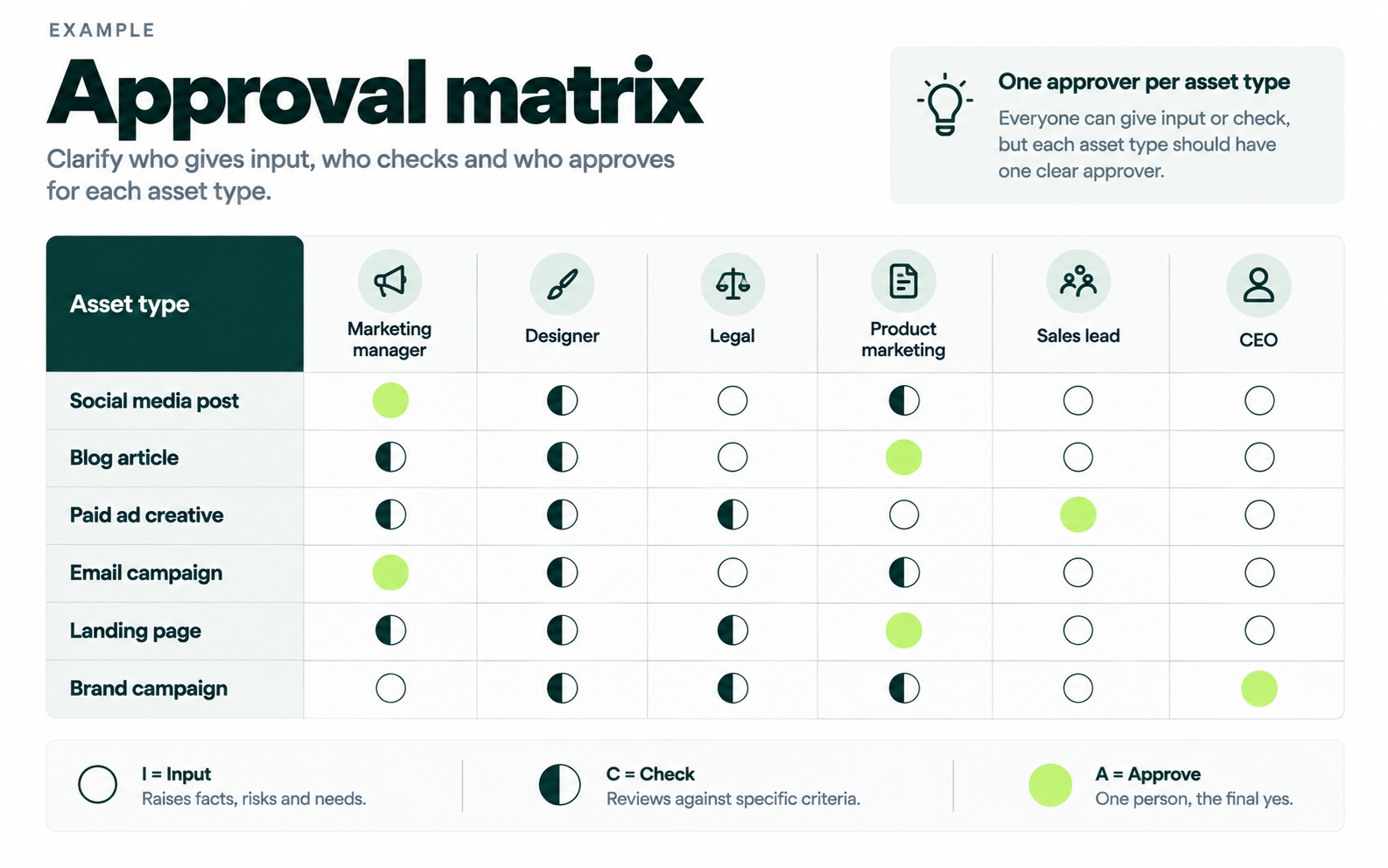
An approval matrix for a small team
Decide the roles once, per asset type, not asset by asset. Here's what that can look like for a small B2B team:
|
Asset type |
Input |
Check |
Approves |
|
Campaign hero |
CEO (at concept), sales, product marketing, brand lead |
Legal (claims) |
Head of marketing |
|
Social posts in an approved campaign |
None needed |
Brand lead |
Content manager |
|
Sales collateral |
Sales lead, head of marketing |
Legal, brand lead |
Product marketing |
|
Website pages |
CEO, sales, product marketing |
Legal, brand lead |
Head of marketing |
|
Homepage |
Head of marketing, sales, product marketing |
Legal, brand lead |
CEO |
Two things to notice. Every row has exactly one approver. And the CEO shows up where their input matters most, early and on the highest-stakes work, instead of on every social post.
The one-round rule: consolidated feedback with one voice
A matrix only works if feedback arrives the right way:
1. All input by one date, in one place, attached to the request.
2. One person consolidates it into a single set of feedback and resolves contradictions before the designer sees anything.
3. The approver signs off on that consolidated version.
"Round" should mean one consolidated message, not six people commenting on three versions in four channels. At Bespire, the Success Manager does the consolidating, and the platform keeps every version, comment and approval attached to the same request, so nobody reviews an old file or repeats a note someone already resolved.
How to give feedback a designer can act on
Describe the problem, not the solution. "Make the logo bigger" is a solution. "People don't know it's us at thumbnail size" is a problem, and it might have a better fix than a bigger logo.
Good feedback has three parts: what isn't working, why it matters for the goal, and what must stay. Flag each point as a must or a nice-to-have, too. The designer can prioritize, and the approver can see what's really at stake.
And not every round is a failure. Seeing a direction and changing your mind is exploration, and it's part of the work. The rounds worth eliminating are the avoidable ones: late stakeholders, contradictory notes, a reviewer who saw the wrong version.
What we see when a loop gets restructured
The loop shapes that produce four rounds are remarkably consistent: reviewers who see different versions, a stakeholder who appears after approval, feedback split across email and chat, and nobody named as the final yes. When a Success Manager restructures a loop, they rarely remove people. They move input earlier, name one approver, and route everything through one consolidated round.
At Bespire, when feedback starts to fragment, the Success Manager steps in before more production happens. They consolidate feedback, resolve contradictions, and make sure the designer is working from one clear set of direction. If the loop continues, they determine whether the remaining changes are still part of the original brief or whether the request has evolved into something new. The goal isn't to stop revisions. It's to get the request to an approved version faster.
This is also why ownership is one of the first things we clarify with a new client, before the first request goes into production.
The conversation with the CEO who wants to see everything
This is usually the hardest part, and it's rarely about ego. CEOs want to see everything because they've been burned by something that went out wrong. Give them a better way to protect the brand:
• Acknowledge the goal. "You want nothing off-brand going out. So do we."
• Offer the high-impact moment. "Your input changes the most at concept stage. Can we get you there on every campaign, instead of on every final file?"
• Name what they approve. "You'll have the final yes on the homepage and anything investor-facing."
• Set the guardrail. "Everything else goes through brand and legal checks, and you'll see it in the queue."
• Make it a trial. "Let's try it for a month and look at what shipped."
Most leaders will take that deal. It gives them more influence, not less, with far less of their time.
Ownership is a workflow deliverable
Design by committee isn't a sign that your team has too many opinions. It's a sign that nobody wrote down whose opinion does what. Write it down once, per asset type, and the same stakeholders who used to take four rounds can get to one.
Frequently asked questions
What does design by committee mean?
It's when a design is shaped by many people's preferences without a clear decision maker, usually ending in compromises nobody is happy with. The cause is rarely the number of people involved. It's the lack of defined roles for who gives input and who approves.
How do you avoid design by committee without excluding stakeholders?
Separate input from approval. Let stakeholders raise facts and risks by a set date, have legal or brand check specific criteria, and give the final yes to one person accountable for the outcome. Consolidate all input into one round before it reaches the designer.
What should a design approval process look like for a small marketing team?
A simple matrix: for each asset type, list who gives input, who checks, and the one person who approves. Add an input deadline and a rule that feedback is consolidated into one message. Revisit it when the team or the asset mix changes.
How do you give design feedback a designer can act on?
Describe what isn't working and why it matters, not the fix you'd make. Say what must stay, and mark each point as a must or a nice-to-have. That lets the designer find the best solution instead of just executing instructions.
How many design revisions are normal?
There's no fixed number, because exploring directions is legitimate work. What's worth eliminating is avoidable rework: late stakeholders, contradictory feedback and reviews of outdated versions. With clear owners and one consolidated round, many assets can be approved much faster.
Where to go from here
Download the free approval matrix template. It includes the matrix (with a check that every asset type has exactly one approver), the one-round rules and a feedback template your reviewers can use.
If you'd rather have someone set it up and run it, see how Bespire works: a Success Manager defines ownership with your team, consolidates feedback, and keeps every request, version and approval in one platform, with a creative team built in.
If one person already approves everything and it works, you don't need either. Keep it that way.