




When Does a Design Subscription for Marketing Teams Actually Make Sense?
Small marketing teams rarely run out of ideas. They run out of hands.
One week, you need five social posts and a couple of ad variations. The next, someone needs a pitch deck by Friday, the website needs an update, and there’s an email campaign waiting on a header.
At some point, “we’ll find a freelancer” stops being a solution.
That’s usually when a design subscription for marketing teams starts to make sense: ongoing creative support for teams that need more design capacity, but aren’t ready (or simply don’t need) another full-time hire.
But it’s not automatically the best option for every team. It depends on what you’re creating, how often you need support, and, more importantly, what you expect that support to do.
What Is a Design Subscription, Exactly?
Think of it as having design support available without hiring someone in-house.
You pay a monthly fee, send in your requests, and a designer or creative team works through them based on priority. Depending on the service, that might include social content, ads, presentations, email graphics, landing pages, web updates, motion, and other day-to-day creative needs.
You’ll see different names for essentially the same model: design subscription, on-demand design, unlimited graphic design, design-as-a-service.
The important part isn’t the label. It’s that instead of finding and onboarding someone every time a new request comes up, you already have creative support in place.
The Problem Small Marketing Teams Are Really Trying to Solve
Usually, it isn’t “we need a designer.”
It’s more like:
“We have way more things we want to launch than we can actually get made.”
That distinction matters.
A small marketing team might be perfectly capable of planning a campaign, writing the copy, building the strategy, and deciding what needs to happen next. But every idea eventually becomes a deliverable.
- The campaign needs ads.
- The webinar needs a landing page.
- Sales needs a deck.
- Social needs next week’s content.
- Someone suddenly needs an event banner by tomorrow.
When all of that depends on one overloaded designer — or whoever on the marketing team happens to know Canva — creative becomes the bottleneck.
And adding random freelancers every time things get busy doesn't necessarily fix it. Now someone has to find them, explain the brand again, manage different working styles, keep track of files, and make sure everything still looks like it came from the same company.
That’s the gap a design subscription is supposed to fill.
Signs a Design Subscription for Marketing Teams Makes Sense
You always seem to have “one more thing”
Your workload doesn’t need to be huge. It needs to be consistent.
If there’s always another ad, presentation, social asset, landing page update, or campaign sitting in the queue, paying for ongoing access can make much more sense than pricing and sourcing every request individually.
It also gives you flexibility. You don't have to predict exactly what you'll need three weeks from now.
Design is slowing down marketing
This one is pretty easy to spot.
- The campaign is ready, but the graphics aren't.
- The copy is approved, but the landing page isn't.
- The presentation is done, but no one has made it presentable.
If this keeps happening, you probably don't have an ideas problem. You have a creative capacity problem.
Your needs don't fit neatly into one design specialty
Marketing teams rarely need the exact same thing every day.
Today it might be social content. Tomorrow, a deck. Next week, a landing page or some motion graphics.
Hiring different freelancers for every specialty can work, but eventually you’re managing a small creative roster yourself.
A good subscription gives you access to a broader creative team through one workflow.
You're spending too much time managing design
This one gets overlooked.
Finding designers, sending assets, explaining brand guidelines, chasing updates, consolidating feedback, checking versions — none of it sounds like a huge task individually.
Together, it can eat a surprising amount of a marketing manager’s week.
The value of a subscription isn't only the number of assets you receive. It’s also how much creative coordination it takes off your plate.
When a Design Subscription Probably Isn't the Right Fit
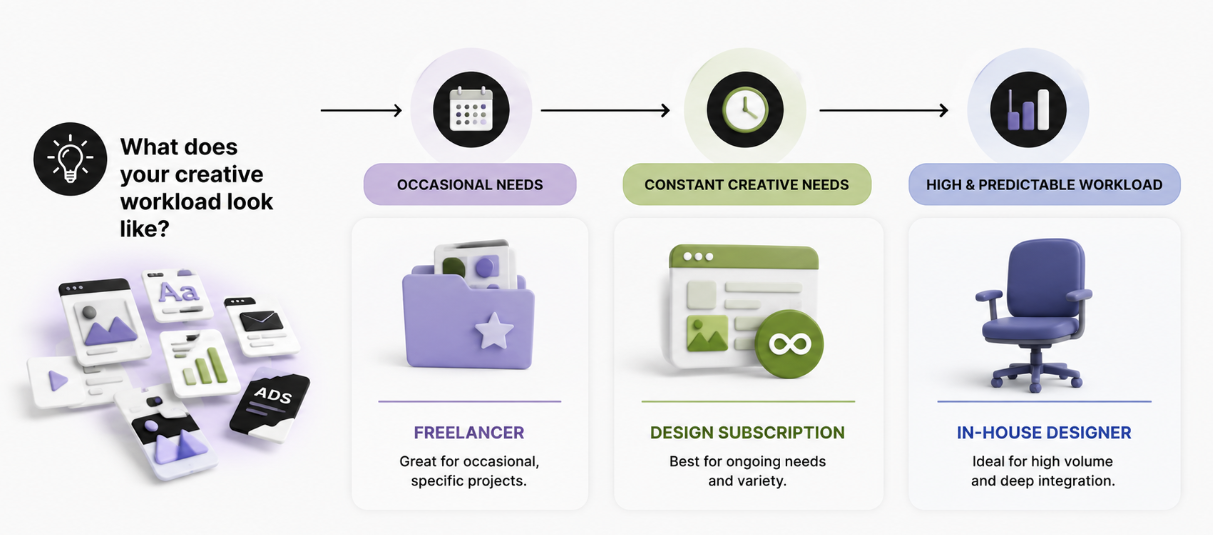
Sometimes, a subscription is simply unnecessary.
If you need three or four graphics every couple of months, find a good freelancer and keep their number.
If you're building an entirely new brand from scratch and need deep positioning, naming, research, and identity work, you may need a branding specialist or agency rather than a production-focused design subscription.
And there’s another important distinction: not every subscription works like a creative partner.
Some services are intentionally execution-focused. You send a brief; they design it.
Others work more collaboratively — helping refine ideas, establish visual direction, improve consistency, or figure out what a request should look like before jumping into execution.
If your team needs the second kind of support, don't choose a service based purely on how many designs it promises per month.
Choose based on how much thinking you need behind the design.
Design Subscription vs. Hiring a Full-Time Designer
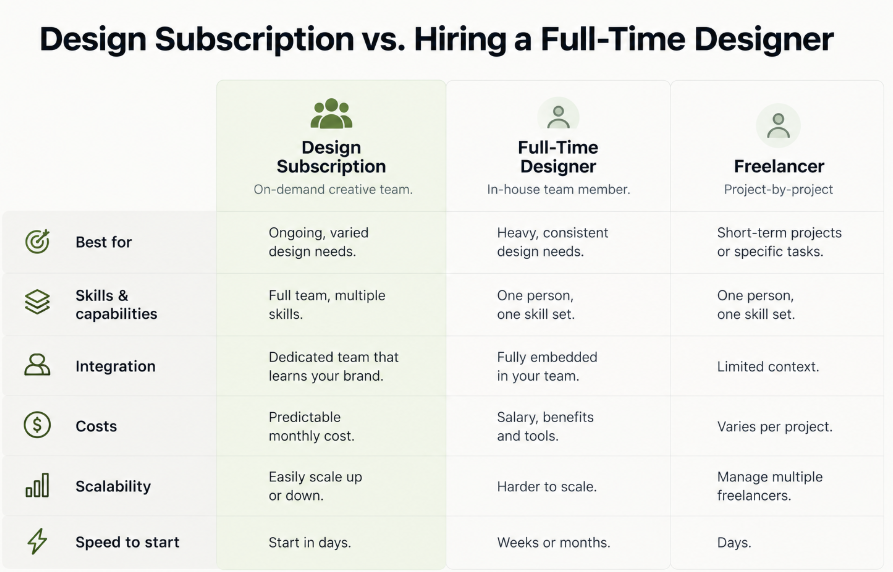
A full-time designer makes a lot of sense when there’s enough work to keep them consistently busy and you want someone deeply embedded in the company.
They’re in the meetings. They know the product. They hear the conversations behind the brief. Over time, they understand the brand almost instinctively.
That's difficult to replicate externally.
But hiring also comes with a much bigger commitment: salary, benefits, software, management, recruiting, onboarding — and you're still hiring one person with one particular skill set.
A subscription gives smaller teams a way to access ongoing creative support before they’re ready to make that commitment.
The question isn't really which model is “better.”
It's whether your current creative workload justifies another employee.
Design Subscription vs. Freelancers and Agencies
Freelancers are great when you know exactly what you need.
Need a presentation designer for one deck? Hire one. Need an animator for a campaign? Same thing.
The model gets messy when those “one-off” requests stop being one-off.
Suddenly you have three freelancers, different rates, different timelines, files living everywhere, and someone internally trying to keep the whole thing consistent.
Traditional agencies sit at the other end of the spectrum. They can bring strategy, creative direction, and larger teams, but that level of involvement usually comes with larger budgets and longer project timelines.
A design subscription sits somewhere between those models.
You get ongoing support without building an internal team, but with more continuity than hiring someone new every time you need something designed.
What Does a Design Subscription Cost?
There’s a pretty wide range.
You’ll find services starting in the hundreds per month and others costing several thousand, depending on the type of work included, turnaround times, seniority of the creative team, and how many requests can be worked on at the same time.
So comparing plans based only on the monthly price doesn't tell you much.
A cheaper subscription that takes a week to complete every request might be far more expensive to your team than a higher-priced service that consistently keeps campaigns moving.
Instead, look at what you're actually getting:
-
How much work can realistically be completed each month?
-
What types of creative work are included?
-
How quickly can priorities change?
-
How much project management will your team still need to do?
-
Will the same people learn your brand over time?
-
Are they only executing briefs, or can they help shape the creative direction too?
That gives you a much better picture of value than the headline monthly fee.
How to Get the Most Out of a Design Subscription
The best relationships don't start with 20 disconnected requests.
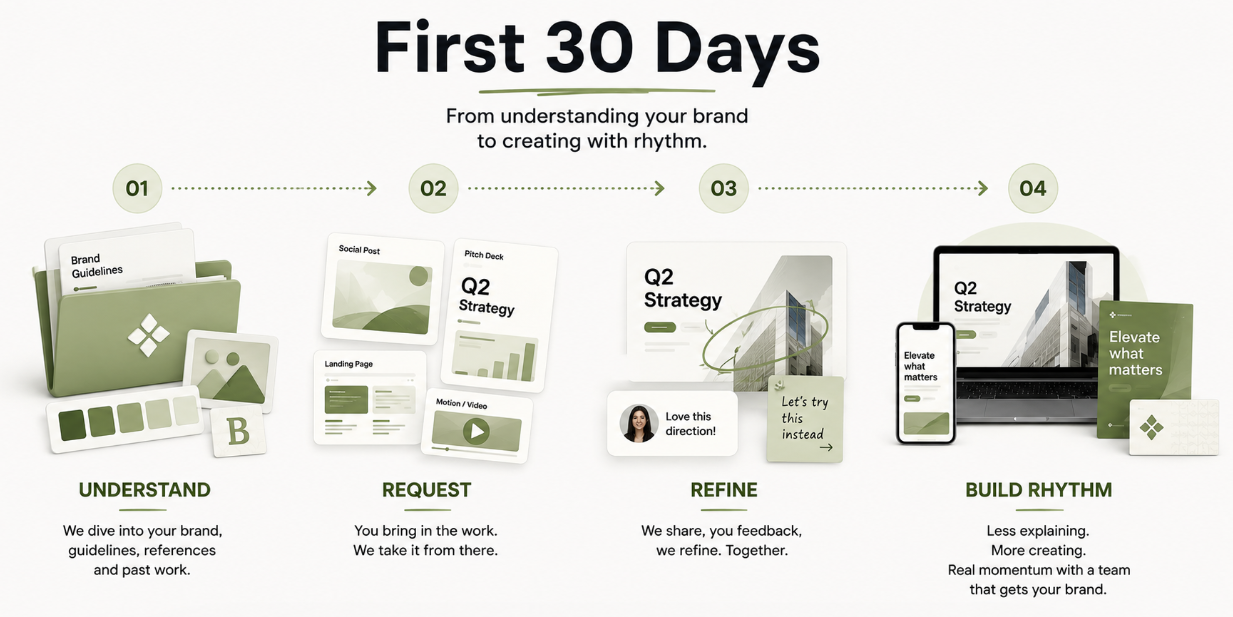
Start with the brand.
Share your guidelines, previous work, references, examples you love, examples you hate, and anything that helps the creative team understand what “on-brand” actually means for you.
Then give context with your requests.
Instead of:
“Make an Instagram post about our new feature.”
Explain what you're launching, who needs to care, what you want them to understand, and where the asset fits into the larger campaign.
And once the team starts understanding your brand, let them use that knowledge.
If every request requires you to prescribe exactly where every element should go, you're still doing part of the designer's job yourself.
The real benefit starts when your creative support understands the brand well enough that you don't have to start from zero every time.
So, When Does It Actually Make Sense?
A design subscription makes sense when creative work has become a constant part of your marketing operation, but building a full internal creative team doesn't make sense yet.
Maybe you're launching faster. Maybe your team has grown. Maybe marketing simply has more channels to feed than it did a year ago.
Whatever the reason, the signal is usually the same:
Design has stopped being an occasional task and started becoming an ongoing need.
At that point, the question isn't whether you'll spend money on design.
You already are. Whether that's in freelancer fees, delayed campaigns, your team's time, or work that simply never gets shipped.
The question is which setup helps your team move without adding more complexity.
And increasingly, the best design subscriptions aren't just selling design hours.
They're becoming an extension of the marketing team — learning the brand, helping create consistency, and turning ideas into finished work without making you rebuild the process every time.
Frequently Asked Questions (FAQ's)
How much does a design subscription cost?
Prices vary widely, from a few hundred dollars per month to several thousand. The biggest factors are usually turnaround time, the type of creative work included, the experience of the team, and how many requests can be worked on simultaneously.
Is a design subscription cheaper than hiring a designer?
For many smaller teams, yes — particularly when there isn't enough consistent work to justify another full-time salary. Once your design needs become large and predictable enough to keep someone busy full-time, hiring internally may make more sense.
What's the difference between a design subscription and a design retainer?
They're similar, but retainers traditionally reserve a certain amount of a freelancer or agency's time each month. Subscriptions tend to be structured around ongoing requests and deliverables rather than a fixed number of hours.
Is “unlimited design” actually unlimited?
Usually, unlimited refers to how many requests you can submit, not how many designs can be produced simultaneously. Most services work through one or a few active requests at a time, so it's worth checking how each provider defines “unlimited.”
Will AI replace design subscriptions?
AI is already changing how creative teams work. It can speed up ideation, production, variations, research, and plenty of repetitive tasks.
But producing something quickly isn't the same as knowing what should be produced in the first place.
Marketing teams still need creative judgment, context, consistency, and someone who understands why an asset exists — not just how to generate it.
The strongest creative services will probably use AI to move faster, while keeping people responsible for the thinking behind the work.