




The Industries that benefit most from a Creative as a Service Model
Every business needs design. But not every business needs it in the same way.
Some industries live on constant visual production. Others compete in spaces so crowded that brand identity is the only real differentiator they have left. And some need to move fast without friction or waiting on a quote.
What they all have in common: a continuous, predictable flow of professional design is not a luxury. It’s part of the operation.
That’s exactly what the Creative as a Service (CaaS) model solves: a dedicated creative team, under a monthly subscription, that produces non-stop and knows your brand inside out. No hiring, no negotiating, no starting from scratch every time.
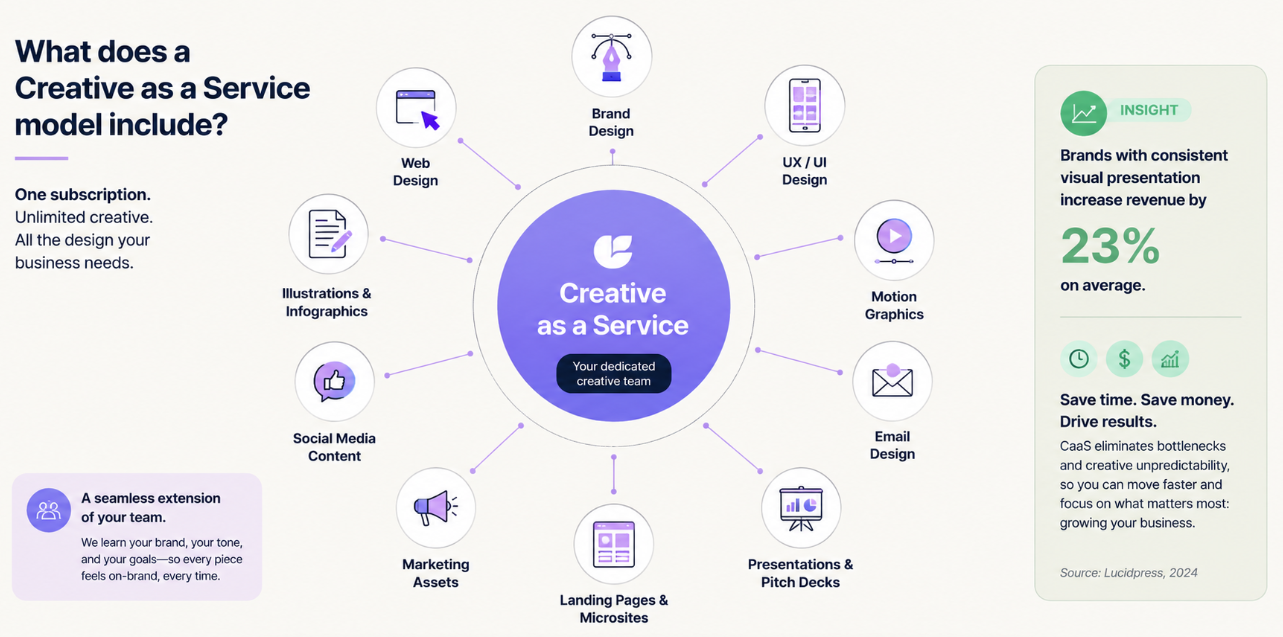
What does a Creative as a Service model include?
Before diving into specific industries, it’s worth clarifying what this model actually covers because it goes well beyond one-off graphic design.
A well-structured CaaS model brings together in a single monthly subscription everything from design and visual brand identity to UX/UI design.
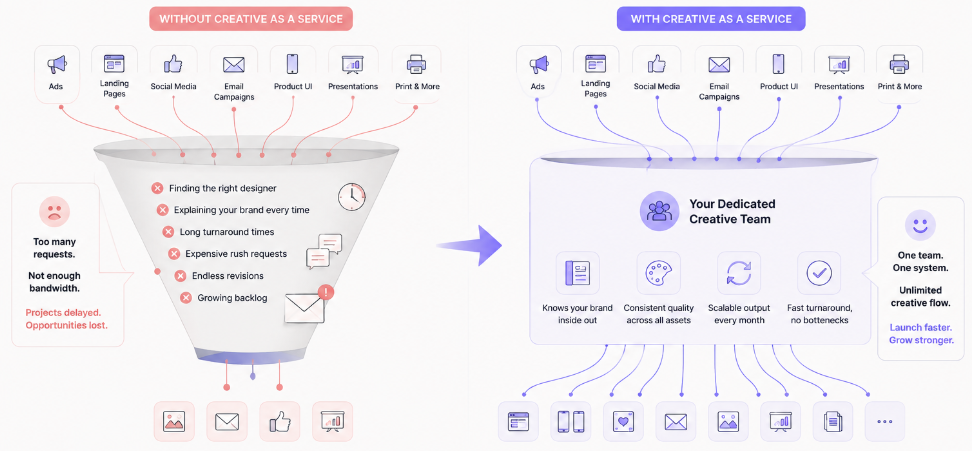
The difference between this and hiring a freelancer or a project-based agency is significant. With freelancers or agencies, you have to explain your brand every time a new need comes up. With a CaaS, the team already knows how you work. Production stops being a bottleneck and becomes a capacity that’s always available.
Sectors where Creative as a Service makes the biggest impact.
1. Startups and Tech Companies / SaaS
When you don’t have a track record, design builds credibility for you.
Startups operate with a structural trust deficit. They don’t have years of reputation, accumulated success stories, or widespread recognition. In that context, visual perception carries more weight than many people admit.
-
Investors form opinions in seconds.
-
First customers assess legitimacy before they assess functionality.
In a SaaS market projected to surpass $900 billion by 2030, design is the first filter that determines whether someone stays or leaves.
On top of that, creative demand in this sector is anything but linear:
-
Investment rounds trigger urgent rebrands
-
Product launches require complete suites of materials
-
Hiring processes demand solid employer branding
-
New features mean constant UI and marketing updates
A Creative as a Service model absorbs those peaks without improvising or paying “urgency” premiums.
2. E-commerce, Retail, and Fashion
In e-commerce, visuals don’t just support the product, they are part of the product.
Unlike a physical store, customers can’t touch or try what they’re buying. So the decision depends almost entirely on what they see on screen.
Visual quality determines whether someone clicks, whether they trust the brand, and whether they ultimately buy.
This is especially relevant considering that the average e-commerce conversion rate in 2024 is 1.65%. In that context, small visual improvements can drive significant revenue impact.
But those improvements don’t happen in isolation. They require constant iteration:
-
Testing different ad creatives
-
Updating product images
-
Adapting assets to new formats
-
Launching visual campaigns for every season
The real challenge for many brands is the variability of that demand. A Black Friday can require 50 assets in just a few days and in January, the need drops to just a handful.
A subscription model absorbs that variability without penalizing either extreme: it produces at high volume when the business demands it and maintains continuity when demand is lower.
3. Health and Wellness
In wellness, design doesn’t just communicate, it builds trust.
According to McKinsey (2024), 82% of U.S. consumers consider wellness an important priority in their lives, and interest continues to grow.
This growth has turned wellness into a $5.6 trillion global industry, with projections to reach $8.5 trillion by 2027. As the sector grows, so does competition and the visual standard of the market rises with it.
In this context, design serves a critical function: it acts as a credibility signal.
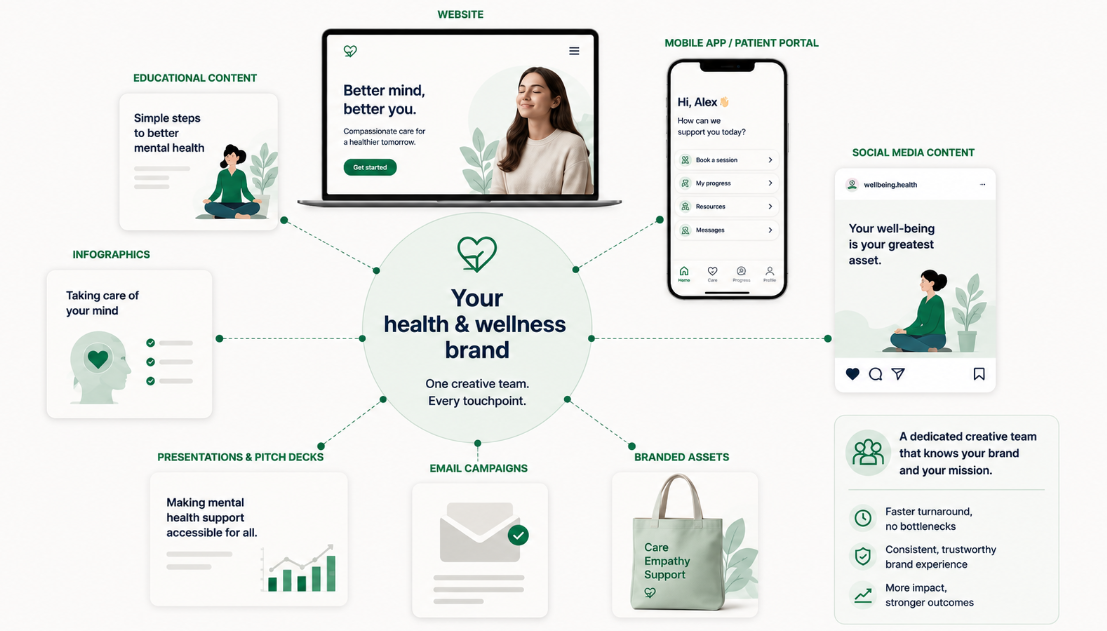
A clear example is Samata Health, a mental health benefits platform for teams and organizations. In a sector where sensitivity and trust are fundamental, Bespire developed a calm, human, and structured visual identity that communicates safety from the very first touchpoint.
The goal was to make the service feel trustworthy even before the first interaction.
That’s why for brands in this sector, visual consistency across every touchpoint, web, product, content, and communication, becomes essential. A Creative as a Service model makes it easier to maintain that consistency without relying on a different creative provider every month.
4. Education and EdTech
The education sector has been facing the same challenge for years: communicating complex information in a way that’s engaging, accessible, and memorable. From traditional institutions to e-learning platforms, the visual challenge is constant.
The EdTech industry has an annual growth rate of 5.39%, with more than 2,900 active startups. In a market expanding at that pace, design is what determines whether an educational platform feels professional and trustworthy or looks like an unfinished project.
For EdTech institutions and platforms, creative demand never slows down: learning materials, infographics, social media content, institutional branding, enrollment campaigns, user interfaces, presentations for partners. All at once, all year long.
A clear example is Skillramp, a platform designed to help digital educators build and scale their online academies. In a space where many tools are powerful but hard to navigate for new creators, Bespire developed a clear, accessible visual identity that communicates simplicity and professionalism from the first touchpoint.
The goal was for the platform to feel approachable and easy to use, aligning brand perception with its purpose of making online academy creation more accessible.
How do you know if your business needs Creative as a Service?
The CaaS model isn’t for every company at every stage. But there are clear signs that the freelancer model or a project-based agency is no longer keeping up with your pace.
-
You produce content inconsistently: Some weeks have a lot of design work, other months have none. The brand ends up looking inconsistent because each piece is made by someone different.
-
Every project starts from zero: You spend time explaining your brand, your tone, and your references every time you bring someone new on board.
-
Urgencies are expensive: When you need something fast, you pay triple. Creative emergencies, last-minute launches, sudden campaigns, always cost more than they should.
-
You have a design backlog that never clears: Requests pile up faster than they get resolved. There’s always something waiting, something delayed and it keeps you from moving forward.
If any of these sound familiar, you’re probably already paying the cost of not having a creative system in place.
One need, many industries
Different sectors, same problem: the need for professional design is constant, but the traditional ways of accessing it, agencies, in-house hires, freelancers, were never built for that kind of sustained demand.
Creative as a Service changes that structure. A team that knows your brand and works as an extension of your business.
Whether you’re scaling an e-commerce brand, building a startup, developing a wellness brand, or transforming digital education, the brands winning in 2026 are the ones that treat design as infrastructure, not as a one-off expense.