




What Actually Happens When a Marketing Team Outgrows Its One In-House Graphic Designer
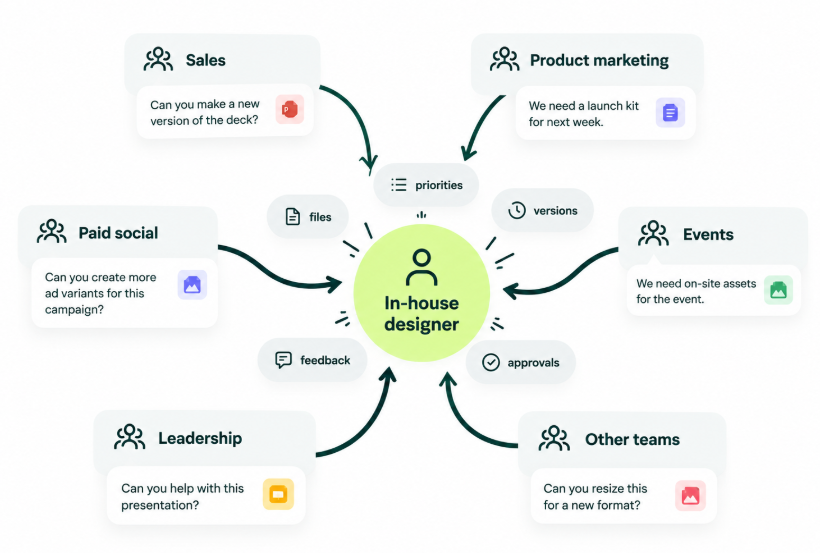
The first sign is rarely a missed deadline. It's a message that starts with "quick one" and sits unanswered until Thursday, because your in-house graphic designer is finishing the webinar deck, resizing last week's ads for a new placement and fixing the one-pager sales needed yesterday. Nobody is doing anything wrong. The designer is fast, knows the brand better than anyone, and has quietly become the busiest point on the marketing calendar.
This is what outgrowing a single designer looks like from the inside. The person who solved your design problem two years ago is now where every request waits. The usual response is to ask whether you should hire or outsource. But that skips a more useful question: what should your in-house designer own from here, and what should be handled around them?
This article looks at the three paths teams typically consider, and what each one looks like at month one, month six and month twelve. One is hiring a second designer, which can be the right call for some teams. Another is the model Bespire is built around. At the end, a five-question quiz helps you figure out which path fits your team.
Year one: why the first designer feels like it solved everything
Before the hire, design was spread across a freelancer who took two days to reply, a founder using a template tool, and a product designer lending hours they didn't have. The first in-house designer replaces that patchwork with one person who sits in the same channels, joins the same launch meetings, and learns the brand from the inside.
The gains are real. Turnaround drops because there's almost no briefing overhead; the designer heard the context in the meeting. Consistency improves because one pair of hands touches everything. Small fixes that used to cost a freelance invoice now take ten minutes. For a lean marketing team, year one with a dedicated designer often feels like finally having a production arm.
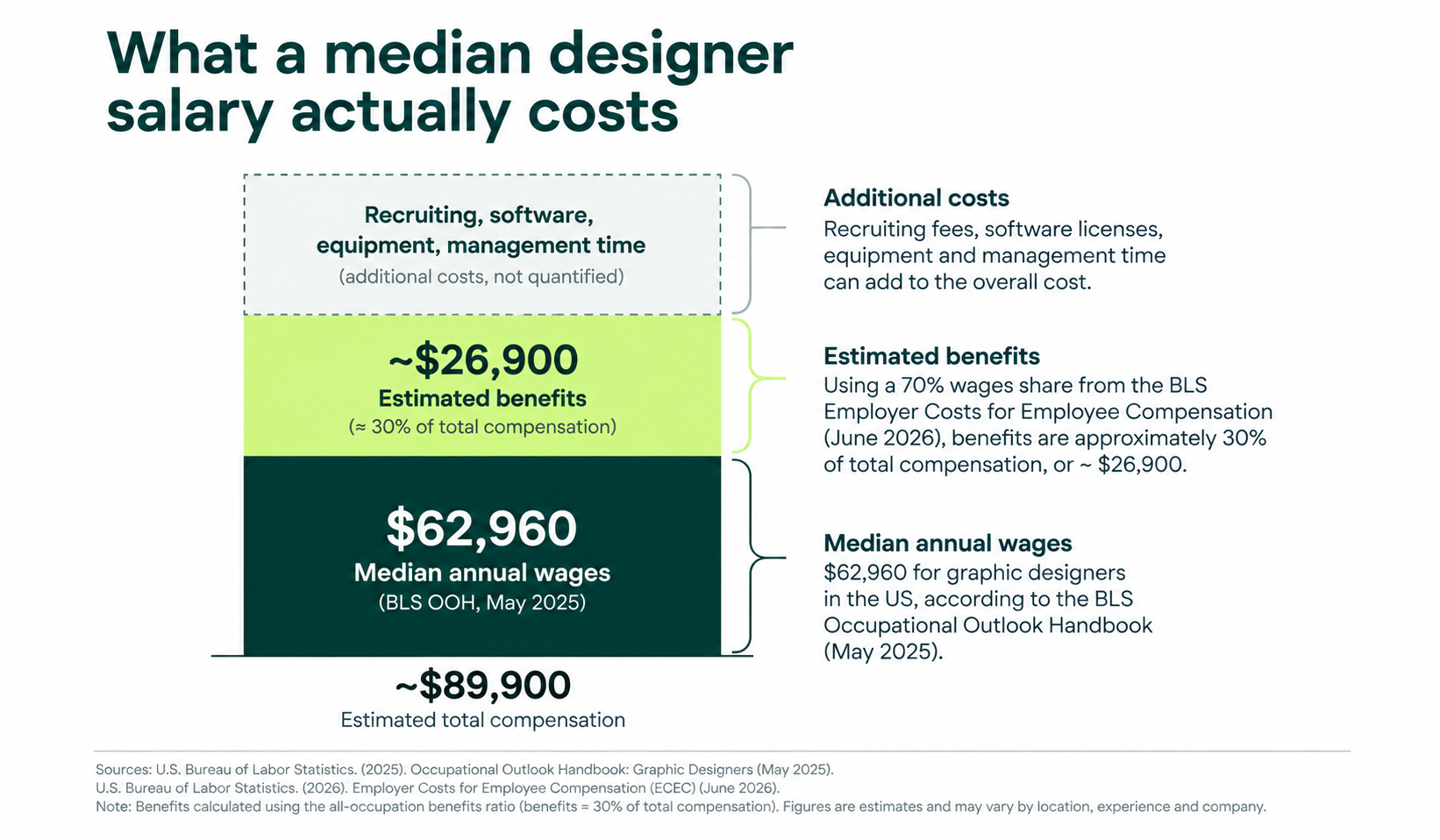
The cost looks manageable too. The median annual wage for graphic designers in the US was $62,960 in May 2025, according to the Bureau of Labor Statistics. Experienced in-house designers at software companies often earn more than the median, but even a senior hire can look cheaper than a year of agency invoices.
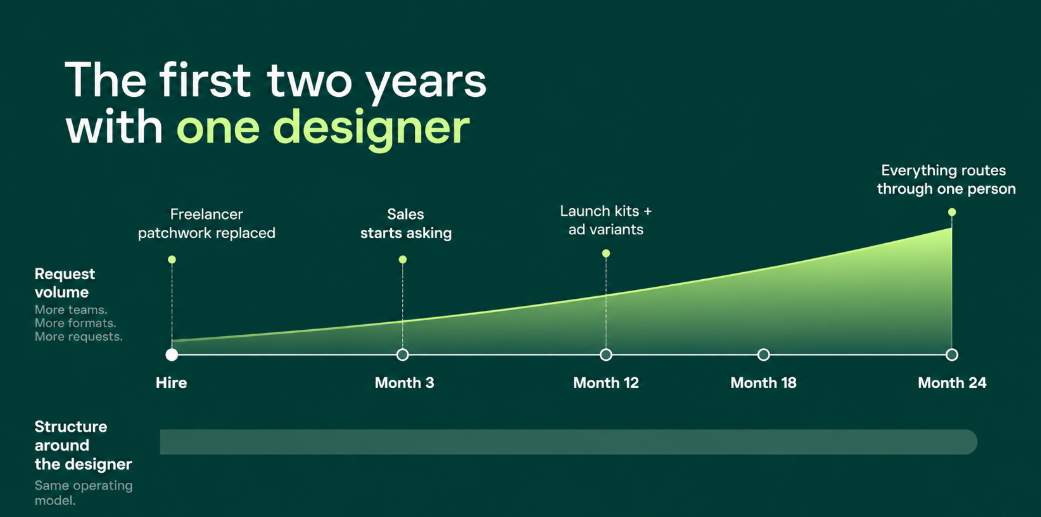
What nobody budgets for is that the designer's success creates demand. Sales learns that decks can look good. Product marketing starts asking for launch kits. Paid social wants more variants to test. The volume that justified the hire keeps growing, while the structure around the designer stays exactly the same: requests in direct messages, priorities agreed in passing, brand decisions stored in one person's head.
The tipping point: signs your designer has become the queue
The shift usually lands somewhere in the second year, and it rarely announces itself. These signals tend to show up together:
-
Prioritization happens in the designer's DMs. Whoever asked last, or whoever is most senior, goes first. The designer is making business trade-offs nobody assigned to them.
-
Only the designer knows where things are. The source files, the approved logo lockup, the font license, last quarter's templates: all findable, but only by asking one person.
-
Brand work and production work compete for the same hours. The brand refresh or the new website direction keeps slipping because this week's resizes are due.
-
"Quick" requests have stopped being quick. Each one needs a question answered first: which version, what size, is this copy final, who approves.
-
Time off becomes a planning event. When the designer is out, work stops.
None of these are performance problems. They’re signs that an entire creative operation, intake, prioritization, production, version control, review and approval, has been compressed into one role.
The designer is now handling the work and everything around it. A request as simple as “just resize this for social” can involve finding the latest version, confirming the approved copy, checking the dimensions, identifying the approver and deciding where it fits in the queue. The resize takes 20 minutes. The coordination around it takes much longer.
This is where teams start asking: Do we hire another designer, bring in an agency, or find another way to handle the volume?
Hire or outsource is the wrong first question
By the time the pressure is obvious, the conversation usually sounds like this: our designer is excellent and completely underwater, a second hire is expensive and slow, an agency feels like overkill, and nobody is sure what the next step is.
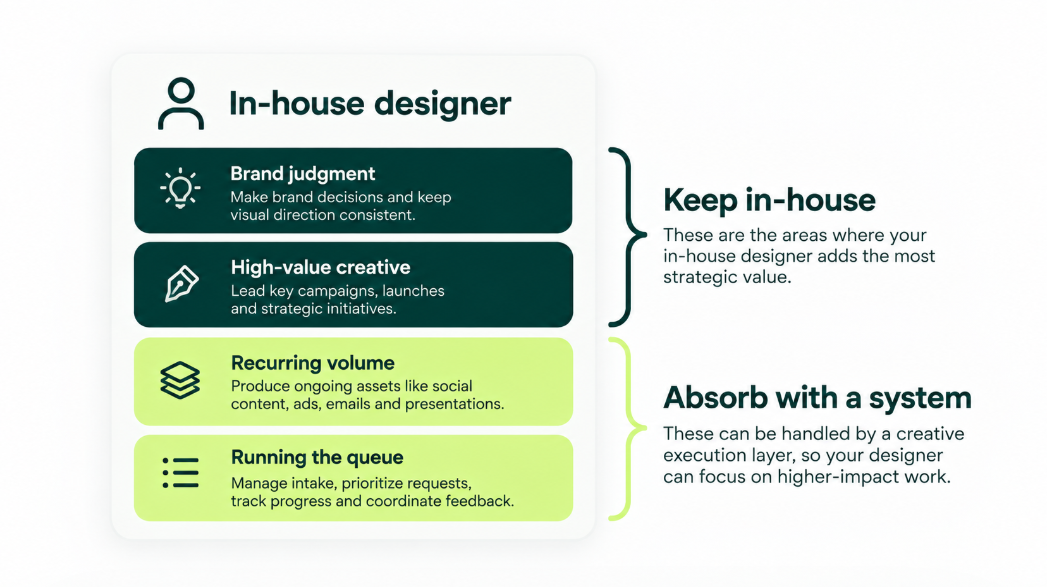
Hire versus outsource assumes the problem is missing hands. Hands are part of it. The bigger issue is that one role is carrying several different jobs at once:
-
Brand judgment: deciding how the brand should look and evolve, leading new directions, protecting consistency.
-
High-value creative work: the launch, the homepage, the deck leadership will present to investors or customers.
-
Recurring volume: resizes, variants, social templates, event assets, sales collateral updates.
-
Running the queue: clarifying requests, chasing files, consolidating feedback, confirming who approved what.
The better question is which of those jobs your in-house designer should keep. In our experience the answer is usually the first two. Brand judgment and the highest-value work belong with the person who knows the company from the inside. Recurring volume, and the operational work around it, can be absorbed by something else. Which something depends on the door you choose.
Door 1: Hire a second in-house graphic designer
The real cost. Salary is only the start. Across US private industry, wages and salaries made up 70% of employer compensation costs in June 2026, with benefits making up the remaining 30%, according to BLS data. Applied to the median graphic designer wage, that puts the fully loaded cost near $90,000 a year, before recruiting, software, equipment and management time. Treat that as a planning estimate, not a quote.
Month one. Nothing ships faster yet. Recruiting takes time, with SHRM's 2025 benchmarking putting median time-to-fill at roughly a month and a half. Then comes onboarding, as the first designer explains the brand, files and unwritten rules.
Month six. Capacity roughly doubles and the pressure eases. Requests are now split between two people, but someone still needs to decide who takes what. That often becomes the first designer, who starts taking on management responsibilities.
Month twelve. You have a small design team, along with a need for intake, prioritization, file management and review.
When this door is right: volume is steady and predictable, the work sits close to the product, and you expect to keep building a design function. If you can already picture a third designer, start here.
What it doesn't fix: the operating model. Two designers without a shared way to intake, prioritize and approve work can quickly become two queues.
Door 2: Bring in a project agency
Agencies are built for defined projects with a start and an end: a rebrand, a campaign concept, a website. For that work they are often the right choice. They bring range, process and an outside perspective your in-house designer rarely has the time to provide.
Month one. Discovery, a kickoff, a scope of work. The agency learns your brand while your designer gets pulled into briefing sessions and asset handovers. For a campaign, that front-loading pays off.
Month six. The campaign ships and looks strong. The weekly stream of resizes, sales one-pagers and event graphics is still sitting with your in-house designer, because it never fit the agency's scope. When teams try to push that stream to the agency, small requests start turning into change orders, minimums and timelines built for bigger work.
Month twelve. You have a relationship that works well for big moments and does little for the weekly load. The coordination cost sits on your side: someone has to brief the agency, route feedback, and keep its output consistent with what your designer produces day to day.
When this door is right: you have a defined, high-stakes project that needs more range than your designer can offer, and recurring volume isn't the main problem.
What it doesn't fix: the weekly stream, which is usually where the queue lives.
Door 3: Put a managed execution layer like Bespire under your designer
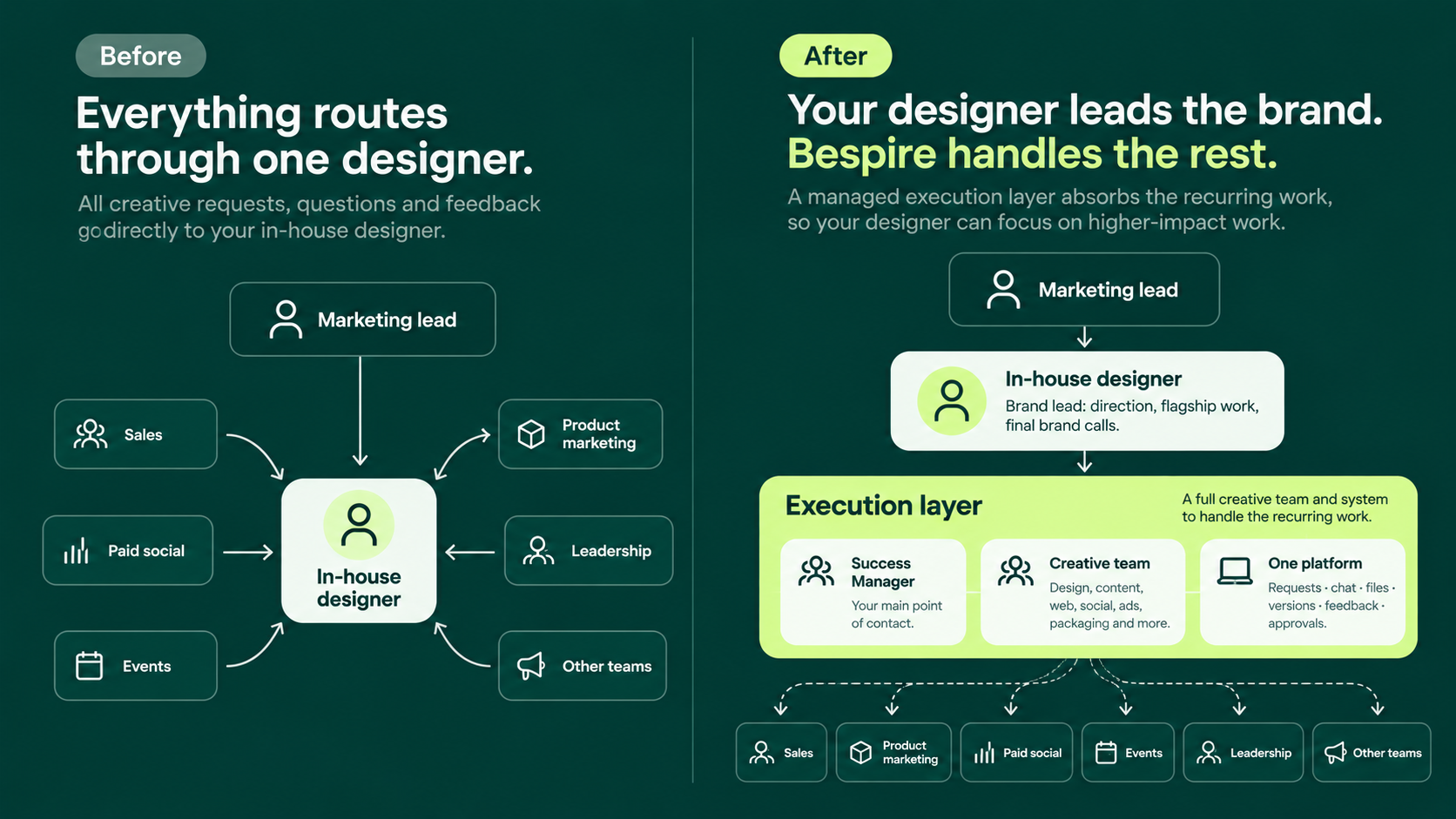
The third option is a layer: a creative team plus someone who manages requests, working inside one connected system. It absorbs recurring volume while your in-house designer stays focused on the brand.
This is the model Bespire is built around: an all-in-one creative operations platform supported by a real team. A Success Manager reviews requests, identifies what's missing, finds the right assets, confirms formats and deadlines, coordinates the creative team, reviews the first version and consolidates feedback. Designers are assigned based on specialization and capacity. The platform keeps requests, files, versions, feedback, status and approvals together.
Month one. The focus is transfer: brand assets, templates, examples of what “on brand” means and a clear list of what your designer wants to keep. The in-house designer stays close, reviewing early outputs and setting the standard.
Month six. The recurring stream runs through the layer. Resizes, variants, collateral updates and event assets move without passing through your designer's inbox. Your designer reviews where it matters and gets time back for work that kept being postponed: the brand refresh, website direction or next campaign concept.
Month twelve. Your in-house designer has effectively become a brand lead with production capacity behind them, without hiring a manager or building a department. Active, waiting and approved work is visible in one place.
When this door is right: the volume is recurring and varied, your designer's judgment is the scarce resource, and you'd rather not build a management layer internally.
What it doesn't fix: an unclear brand or an undefined approval process. A Success Manager can surface those gaps, but your team still needs to resolve them. If most of the work lives inside product UI, an in-house hire may be a better fit.
What the hand-off looks like from the inside
Teams often worry that bringing in outside capacity sidelines the designer they already have. The transitions that work are the ones where the in-house designer helps define what stays with them and what moves to the execution layer.
The in-house designer keeps new creative directions, flagship assets and final brand calls. Bespire handles work that follows an established system: campaign adaptations, social versions, sales collateral and event assets. Anything in between is decided request by request, with the Success Manager flagging when the designer's input is needed.
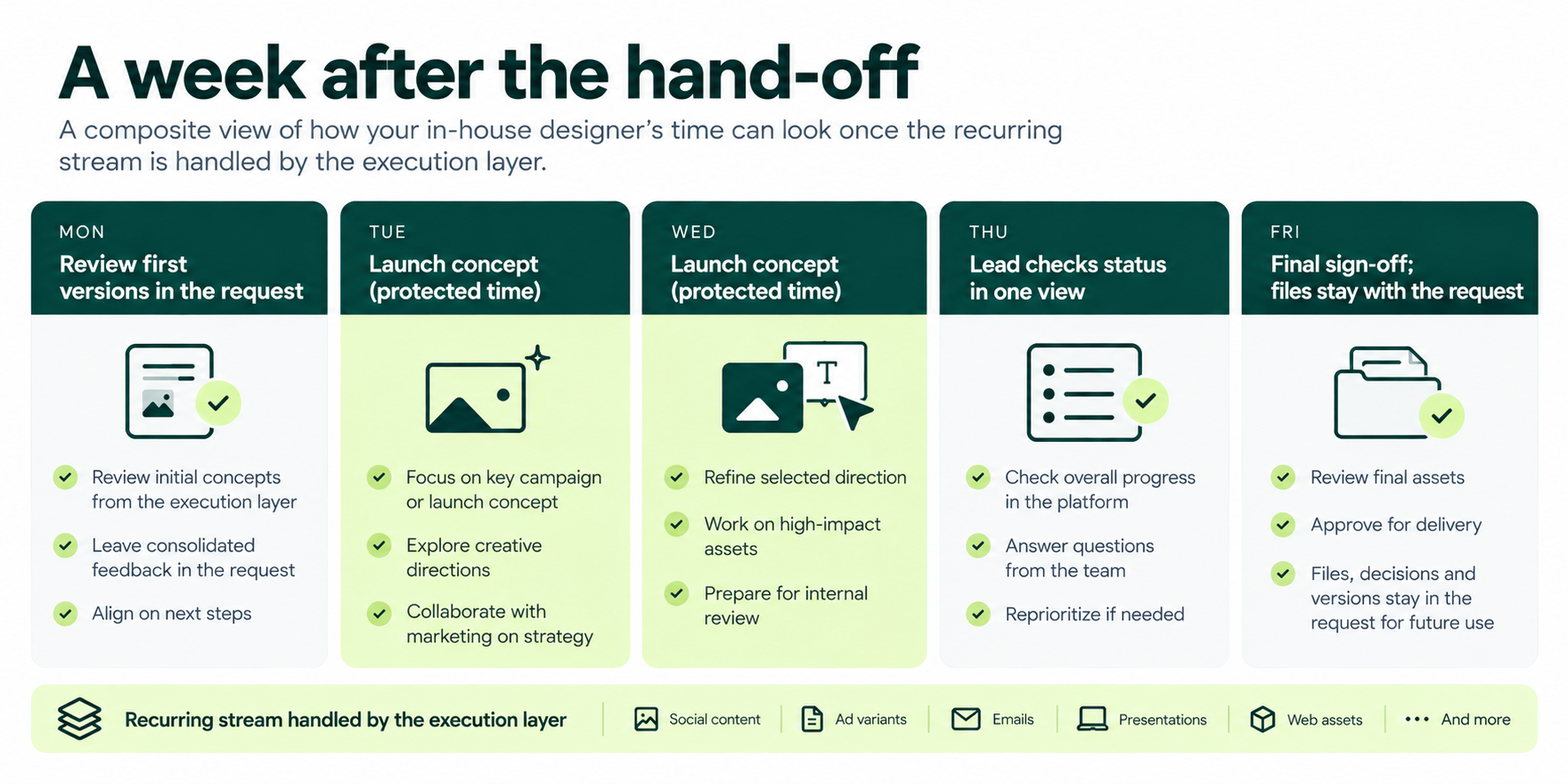
For example, a designer who used to spend most of the week on social adaptations, sales collateral and campaign resizes can now review those requests through the execution layer while keeping final approval and creative direction in-house. The recurring production keeps moving, while the designer gets time back for brand work and new creative projects.
Two things make this work: request readiness and request continuity. The right questions are answered before production starts, while instructions, files, versions, feedback and approvals stay connected to each request. The designer can review the work in context instead of reconstructing it each time.
The brief explains the work. The platform keeps everything around the work connected.
Quiz: which door fits your team?
Five questions. Answer for the last quarter, not the one you're hoping for, and keep track of your letters.
1. Where does most of your designer's week go?
A Resizes, variants, templates and collateral updates
B Product UI and work that sits close to the product
C One or two big projects: a rebrand, the website, a campaign
2. How do requests reach your designer?
A DMs, email and meetings: whoever asks first
B Through a process that works. We just need more hands
C The process is fine. We need skills we don't have in-house
3. Who sets priorities and gives final approval?
A In practice, the designer. Or nobody clearly
B A marketing lead, with a clear process
C It changes from project to project
4. Do you want to manage more people?
A No. We'd rather not add a management layer
B Yes. We're building a design function
C Only for a project with an end date
5. What has your designer been postponing?
A Brand-level work: a refresh, a new direction, flagship assets
B Nothing in particular. We just need a second pair of hands every week
C A big project we can't start without outside help
Your result
Mostly A's: Bespire. Your designer doesn't need a peer to manage. They need a team underneath them. With Bespire, a Success Manager makes each request ready, a creative team handles the recurring stream, and one platform keeps requests, chat, files, versions, feedback and approvals together. Your designer stays the brand lead.
Mostly B's: a second in-house hire. Your work is steady, close to the product and part of a design function you plan to grow. Hire, and set up a shared intake and approval process so two designers don't become two queues. If the backlog can't wait for recruiting, Bespire can cover the recurring stream in the meantime.
Mostly C's: a project agency. Your pressure comes from one defined, high-stakes project. Bring in an agency with the right specialty, and keep your designer in the briefing so the brand stays consistent. If the weekly stream piles up again after launch, that's where Bespire fits.
A mix of A's and C's: both. Bespire for the weekly stream, an agency for the big project, and your designer as brand lead across the two.
Here is how the three doors compare over the first year:
|
Month one |
Month six |
Month twelve |
Best fit |
|
|---|---|---|---|---|
|
Second in-house hire |
Recruiting and onboarding; queue briefly slower |
Capacity up; requests split across two people |
A small team that now needs process |
Steady, product-close volume; growing design function |
|
Project agency |
Discovery and kickoff; designer pulled into handovers |
Big project ships; weekly stream unchanged |
Strong for big moments, light on weekly load |
Defined, high-stakes projects |
|
Managed execution layer |
Brand transfer; designer sets the standard |
Recurring stream moves off the designer |
Designer works as brand lead with capacity behind them |
Recurring, varied volume; designer judgment is scarce |
Plenty of teams end up combining doors: an agency for the annual campaign, an execution layer for the weekly stream, and a second hire later, when the design function is ready to grow.
Keep your designer. Give them a team.
Teams outgrow a single in-house graphic designer because the role worked, not because it failed. The designer became valuable enough that everything started routing through them. The fix is rarely to replace that person, or to bury them under a second hire they now have to manage. It's to decide deliberately what they should own, and to build or bring in a system that handles the rest.
When volume, requests and approvals have somewhere to live other than one person's inbox, your designer gets back to the work you hired them for.
Frequently asked questions
When should a company hire a second in-house graphic designer?
When the recurring design workload is steady enough to keep another full-time person busy every week, the work sits close to the product, and you plan to keep growing a design function. If the pressure is mostly recurring production that follows an existing brand system, a managed execution layer may relieve it faster. Either way, set up how requests are prioritized and approved first, or two designers become two queues.
How much does it cost to hire an in-house graphic designer?
The US median wage for graphic designers was $62,960 in May 2025 (BLS). Benefits typically add a significant layer on top: across private industry, wages were 70% of total compensation costs in June 2026, which puts a median designer near $90,000 fully loaded. Recruiting, software, equipment and management time come on top of that.
Is it better to have an in-house designer or outsource graphic design?
It usually isn't either-or. An in-house designer is strongest on brand judgment, product context and high-value work; outside capacity is strongest on recurring volume or defined projects. Many teams keep the in-house designer as brand lead and move repeatable production to an agency or a managed layer, depending on whether the work is project-based or ongoing.
Will outsourcing design work replace my in-house designer?
It shouldn't. The setups that work well keep the in-house designer responsible for brand direction, flagship assets and final brand calls, and move only work that follows an established system. The in-house designer typically reviews early outputs and defines what they want to keep, which protects both the brand and their role.
What are the signs a graphic designer is overloaded?
Priorities being set in the designer's direct messages, only one person knowing where source files and approved versions live, brand projects slipping behind routine resizes, and work stopping whenever the designer is out. These are usually signs of a missing operating model rather than a performance problem.
What is a managed creative execution layer?
It's external creative capacity with its own operational owner and one connected system. A Success Manager makes each request ready for production, a creative team produces the work, and a platform keeps the request, chat, files, versions, feedback and approval together. It differs from a freelancer because it isn't one person, and from a project agency because it's built for the recurring weekly stream. Bespire works this way, usually alongside an in-house designer who stays the brand lead.
Where to go from here
If you want to go deeper than the quiz on your own, the free Designer Capacity Audit is a one-week log that sorts your designer's requests into brand judgment, high-value work, recurring volume and queue management.
If your team needs one place to manage requests, conversations, files, feedback, revisions and approvals, with a Success Manager and a creative team built in, that's what Bespire is designed for. See how it works, or book a workflow review and we'll map what your in-house designer should keep.