




7 tips to increase team productivity (that have nothing to do with creativity)
Your team has ideas. Probably too many of them. What it doesn't have is a reliable way to turn those ideas into results on time, consistently, without everything feeling like a last-minute scramble.
That's not a creativity problem. That's an execution problem.
And it's more common than most managers want to admit. As teams grow, so do the requests, the stakeholders, the feedback rounds, and the competing priorities. What used to run on instinct and shared context now needs a system. Most teams never build that system; they just add more people and more meetings and hope things get faster.
Spoiler: They don't.
In this article, we break down exactly why execution (not creativity) is the real bottleneck holding your team back, and share 7 practical tips to increase team productivity by fixing the system, not the people.
Why creativity is not your team's biggest problem
When a team starts missing deadlines or campaigns keep getting delayed, the first instinct is usually the same: "We need to think differently. We need to be more creative." So the team schedules a brainstorming session, tries a new ideation framework, or brings in someone to shake things up.
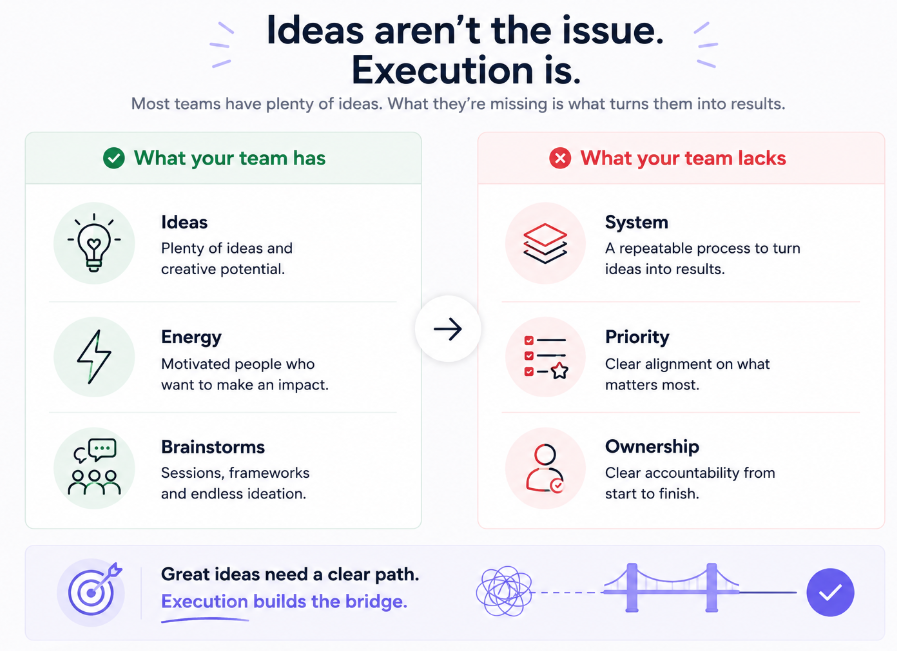
But here's the uncomfortable truth: most teams are not short on ideas. They have plenty of them. What they're short on is the ability to execute those ideas consistently, without things falling apart halfway through.
The creativity conversation is a distraction. It feels productive because it's energizing and forward-looking. But it doesn't solve the actual problem. And until you identify the real bottleneck, no amount of creative thinking will move the needle on team productivity.
The real reason teams fail to deliver: execution
Execution is everything that happens between having an idea and shipping a result. It's the process of turning a brief into a campaign, a concept into a landing page, a strategy into content that actually goes live.
And execution breaks down; quietly and gradually, as teams grow.
When a team is small, execution is informal. Everyone knows what's happening, who's doing what, and what comes next. But as the team grows, so do the requests, the stakeholders, the revision rounds, and the competing priorities. What used to run on shared context now needs a system. And most teams never build that system. They just add more people, more tools, and more meetings, and wonder why things are still slow.
The result is a team that's constantly busy but rarely moving forward. Sound familiar?
How poor execution kills team productivity
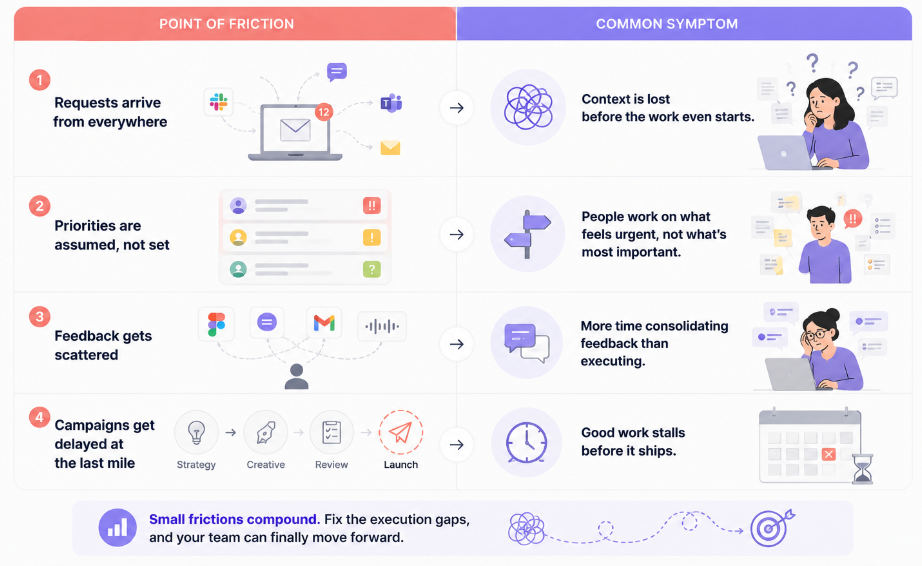
Poor execution doesn't announce itself. It shows up as friction. Small inefficiencies that compound over time until the whole team feels stuck. Here's what it typically looks like:
-
Requests arrive from everywhere. Someone sends a brief over email. Another person drops a reference on Slack. A third mentions something in a meeting that never gets written down. By the time the work starts, half the context is already lost.
-
Priorities are assumed, not set. Everyone is working hard, but not necessarily on the same things. Without explicit prioritization, each person defaults to what feels most urgent to them; which rarely matches what's most important to the business.
-
Feedback gets scattered. One stakeholder comments in Figma. Another replies to an old email thread. A third sends a voice note. The person doing the work now has to spend more time consolidating feedback than acting on it.
-
Campaigns get delayed at the last mile. The strategy is solid. The creative direction is clear. But the actual assets; the social posts, the ads, the landing page, are stuck waiting because nobody owns the execution end-to-end.
This is the execution gap. And it's far more common than most managers want to admit.
7 tips to improve team productivity through better execution
These aren't creativity hacks. They're systems and habits that make execution reliable, so your team spends less time coordinating and more time delivering.
1. Centralize where requests come in
Pick one place for all work requests and make it non-negotiable. Whether that's a project management tool, a shared form, or a dedicated platform, the channel matters less than the consistency. When everything lives in one place, prioritization becomes possible and nothing falls through the cracks.
2. Set priorities out loud (every week)
Make priority-setting a weekly ritual, not an assumption. A simple ranking of the top 3–5 active projects, visible to everyone, eliminates the guesswork that slows teams down. When people know what matters most this week, they stop second-guessing and start executing.
3. Reduce the number of feedback channels
Establish one channel for feedback on each type of work and stick to it. This protects the person doing the work from having to chase down comments across five different platforms, and it speeds up revision cycles significantly.
4. Separate urgent from important
Not every request is an emergency, even when it feels like one. Build a simple triage habit: when something comes in, categorize it immediately. Does this need to happen today, this week, or this month? This protects your team's focus and prevents the reactive spiral that kills long-term productivity.
5. Build a repeatable workflow
The best-performing teams don't reinvent the process every time a new project starts. They have a standard workflow: how requests are submitted, how work moves through review, how feedback is given, and how final assets are delivered. Document it once, refine it over time, and let it run.
6. Track progress visibly
If the status of a project lives only in someone's head, it's a bottleneck waiting to happen. Use a shared board, a simple tracker, or any tool that makes progress visible to everyone who needs to know. Visibility reduces the need for status meetings and keeps work moving without constant check-ins.
7. Stop managing creative work through email and slack
Email threads and Slack channels are where creative briefs go to die. They're great for communication, but terrible for managing ongoing creative production. When briefs, feedback, revisions, and final files are scattered across messages, the coordination cost becomes enormous. Creative work needs its own dedicated space.
How teams like yours are solving the execution gap
Knowing what to fix is one thing. Building the system to fix it is another.
Many growing teams reach a point where the execution problem is clear, but solving it internally feels impossible. Hiring more people adds headcount without adding structure. Using more tools adds complexity without adding clarity. And managing freelancers or agencies introduces new coordination overhead on top of an already fragmented workflow.
This is exactly the gap that platforms like Bespire were built to solve. Bespire is a Creative as a Service platform that acts as a dedicated creative layer between strategy and execution; giving teams a centralized system for requests, priorities, feedback, and creative production, without the overhead of building and managing an internal team.
Instead of chasing briefs across Slack threads and email chains, teams using Bespire work through one workflow, with one dedicated creative team, in one place. The result is faster execution, more consistent output, and significantly less time spent on coordination.
It's not a magic fix for every productivity challenge, but for teams whose execution bottleneck is specifically in creative production, it removes one of the most common sources of friction entirely.
The bottom line: Team productivity starts with execution, not ideas
If your team is struggling to deliver, resist the urge to schedule another brainstorming session. Chances are, the problem isn't a lack of good ideas; it's a lack of the systems needed to turn those ideas into results.
Start by auditing where execution breaks down in your workflow. Where do requests get lost? Where does feedback pile up? Where do projects stall before the finish line? Those are your real bottlenecks.
Fix the execution system, and team productivity follows. It's that simple.