




What Is a Wellness Flyer (and when clinics actually need one)
A wellness flyer is a single-page promotional piece, print or digital, designed to encourage one specific action, whether that's booking a health screening, registering for a wellness workshop, attending a community event, or remembering your practice when care is needed. Unlike broader marketing materials, a flyer works best when it focuses on a single message and a single goal.
Clinics and wellness organizations commonly use wellness flyers to promote health fairs, seasonal screening campaigns, new-patient offers, open enrollment periods, and employee wellness initiatives. They're inexpensive to produce, easy to distribute, and flexible enough to work across waiting rooms, pharmacies, community events, workplaces, and digital channels.
Even in a digital-first world, printed flyers continue to play an important role because they reach people in places where health decisions are often made. Healthcare direct mail campaigns average a 4.09% response rate, closely matching the broader direct mail benchmark of 4.4%. When paired with clear messaging, a compelling offer, and an easy way to respond, wellness flyers remain a practical and cost-effective way to increase awareness, encourage participation, and generate qualified inquiries.
Ultimately, a flyer's success depends less on the format and more on how clearly it communicates value and motivates someone to take the next step.
Why templates alone don't win patients
A blank template solves layout, not persuasion. Swap in your clinic's logo and colors, and you'll end up with something that looks professional, but not necessarily memorable or convincing. Patients don't respond to polished layouts alone; they respond to messages that feel relevant to their needs and make it easy to take action.
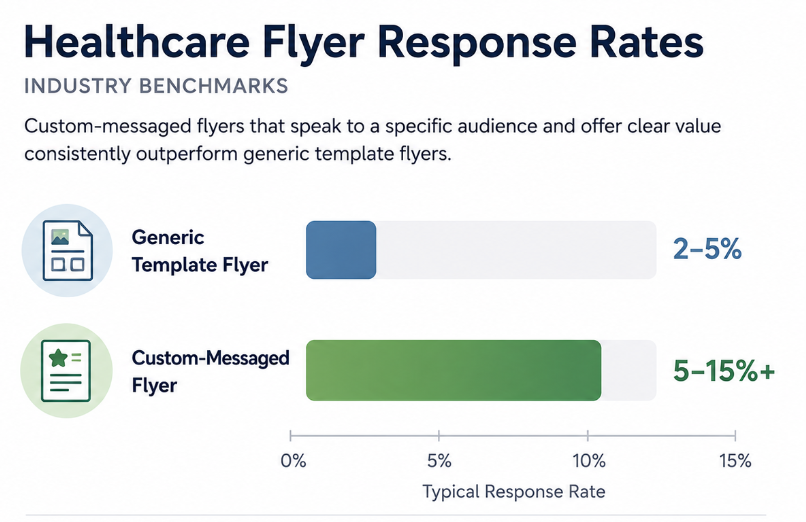
The difference isn't the template itself, it's how it's used. High-performing wellness flyers treat templates as a starting point, then add the elements that actually influence decisions: a specific offer, clear trust signals, and a simple next step.
The 5 elements every wellness flyer needs
Most flyers try to say everything. The ones that convert say one thing clearly, then support it.
Headline and core offer
Lead with the benefit, not your clinic's name. A headline like "Free Mental Health Check-In This Week", "Join Our Workplace Wellness Workshop" immediately tells people why they should keep reading.
Trust signals
Healthcare decisions are built on trust. Include details that reassure potential patients they're in good hands, such as your team's credentials, years of experience, professional certifications, or a short patient testimonial if you have permission to use it.
Trust doesn't have to take up much space on the flyer, but it should be visible enough to answer the question, "Why should I trust this provider?”
Clear Call-to-Action
Every flyer should ask readers to do one thing—and make that action as simple as possible. Whether it's scanning a QR code, calling your clinic, or booking online, the next step should take only a few seconds.
Instead of simply displaying a QR code, tell people what they'll get by using it with phrases like “Scan to Register”, “Book Your First Session"
Authentic images
Skip generic stock photos whenever possible. Real photos of your clinic, healthcare professionals, facilities, or wellness events help people picture the experience before they arrive and create a stronger sense of authenticity.
A way to measure results
A flyer shouldn't leave you guessing whether it worked. Include something that helps you track responses, such as a unique QR code, booking link, or promo code tied specifically to that campaign.
Messaging that works for health & wellness audiences
Wellness audiences respond best to messages that are both specific and reassuring. Generic phrases like "feel your best" or "a healthier you" have been used so often that they rarely stand out. Instead, tell readers exactly what you're offering, when it's available, where it takes place, and whether there's a cost.
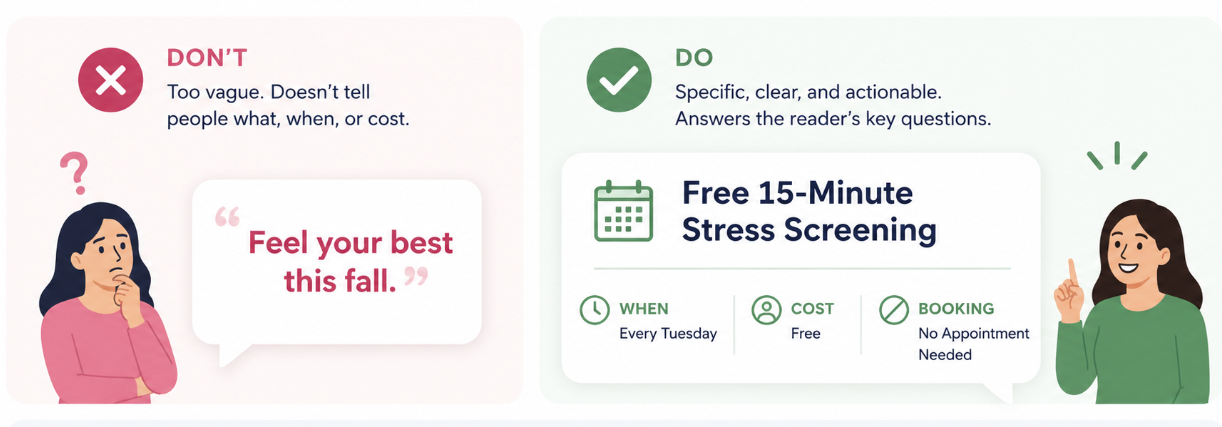
The second example answers the questions people naturally ask before deciding to take action.
Whenever possible, focus on what people can gain rather than what they should fear. Highlight outcomes like reducing pain, managing stress, sleeping better, or feeling more energized. If you're promoting screenings or preventive care, adding a gentle sense of urgency can also be effective, encourage early action without relying on fear or exaggerated claims.
Keep the language simple and approachable. Avoid unnecessary medical jargon, and reduce uncertainty with phrases like "No referral needed," "Insurance accepted," or "Same-week appointments available."
Before you print, try the 5-second test: show the flyer to someone unfamiliar with it. If they can't quickly explain what it's about, who it's for, and what to do next, simplify the message before it goes to print.
Design principles for health-context flyers
A flyer doesn't need to be flashy to be effective. In healthcare, a clean and professional design helps build trust before a patient reads a single word. In fact, studies suggest that 75% of people judge a business's credibility based on its visual design, making first impressions especially important for clinics and wellness providers.
Color Psychology in Wellness Marketing
Color influences how patients perceive your practice before they read a single word.
-
Blue and green: The safest choice for most medical and wellness services. Blue conveys trust and professionalism, while green is associated with healing, wellness, and calm.
-
Warm palettes (coral, soft yellow): Better suited for community wellness events, family programs, or health fairs where the goal is to feel approachable rather than highly clinical.
-
Avoid overly bright colors: Neon or high-saturation palettes can make a health flyer feel more promotional than trustworthy. A clean, balanced color scheme is more likely to inspire confidence.
Readability and accessibility
Whether it's displayed in an office, shared digitally, or handed out at a wellness event, a flyer should be easy to understand in just a few seconds. Clear typography, thoughtful spacing, and a strong visual hierarchy help people quickly recognize the value of the program and know what to do next.
|
Design Element |
Best Practice |
Why It Matters |
|
Body Font Size |
Use at least 14 pt for body text (18 pt for older audiences). |
Makes important information easier to read at a glance. |
|
Font Style |
Choose simple sans-serif fonts like Arial, Helvetica, or Calibri. |
Improves readability and gives the flyer a clean, professional look. |
|
Color Contrast |
Use dark text on a light background and avoid low-contrast color combinations. |
Ensures readers can quickly scan the flyer without straining their eyes. |
|
Visual Hierarchy |
Make the headline, offer, and call-to-action the most prominent elements. |
Helps readers find the most important information in seconds. |
|
White Space |
Leave enough space between sections instead of filling every inch with content. |
Keeps the flyer uncluttered and makes the message easier to absorb. |
Wellness flyer ideas by use-case
Wellness Fair & Event Flyers
These flyers should answer the practical questions first: what's happening, when, where, and why it's worth attending. Include session times, booth locations, or featured activities, and give people one compelling reason to stop by, whether it's a free screening, a guest speaker, a giveaway, or an exclusive resource.
Corporate & Employee Wellness Flyers
Employees already know the organization behind the program, so the focus can shift from building trust to encouraging participation. Keep the message clear and action-oriented by highlighting the benefit, key dates, how to enroll, and where to find more information.
Workshop & Seminar Flyers
Instead of simply naming the event, highlight what attendees will learn or achieve. A headline like "Learn Practical Strategies to Manage Workplace Stress" is more compelling than "Mental Health Workshop" because it promises a clear outcome and helps people understand the value of attending.
Where to distribute wellness flyers (Print vs. Digital)
Print still earns its place in waiting rooms, community boards, and local health fairs—anywhere people are already thinking about their health. Digital versions of the same flyer work just as well in email campaigns, social media, employee newsletters, or patient portals, helping you stay visible throughout the patient journey.
Rather than creating separate campaigns, adapt the same flyer to the channel where it will be seen.
|
Channel |
Best Used For |
Recommended CTA |
Update Frequency |
|
|
Health fairs, waiting rooms, community spaces, workplace bulletin boards |
QR code to book an appointment or learn more |
Review every 3 months to keep dates, offers, and contact information current. |
|
Digital |
Email, social media, employee communications, patient portals |
Direct booking link or "Learn More" button |
Update anytime as details change—no reprinting required. |
A hospital quality improvement study found that 100% of patients aged 80+ preferred printed health information, while adults 15–65 were more likely to prefer digital formats. Matching your distribution channel to your audience can improve engagement.
The strongest campaigns reuse one core design across both formats, adjusting only the call-to-action. Keep printed flyers up to date by reviewing them regularly to ensure dates, offers, and contact information remain accurate.
Compliance considerations for health & wellness flyers
Anything mentioning specific health conditions, screenings, treatments, or outcomes should be reviewed against your organization's compliance guidelines before it's printed or shared. This is especially important for flyers that include patient testimonials, before-and-after images, or information about insurance coverage.
Before distributing your flyer, make sure you've covered these essentials:
-
Use accurate, supportable claims. Avoid promising guaranteed results or making statements that can't be verified.
-
Protect patient privacy. Only use testimonials, photos, or personal stories when you have the appropriate permission.
-
Review offers and coverage details carefully. Make sure pricing, eligibility, and insurance information are current and clearly explained.
-
Get a final review before printing. Fixing a digital file is easy, reprinting hundreds of flyers isn't.
When in doubt, keep claims general and encourage readers to contact your team for personalized guidance. It's much easier to answer questions directly than to correct misleading or outdated information after a flyer has already been distributed.
How to measure if your flyer is working
A flyer without a way to measure results is a missed opportunity to improve future campaigns. Tracking responses helps you understand which locations, offers, or messages generate the most interest, so you can make better marketing decisions instead of relying on assumptions.
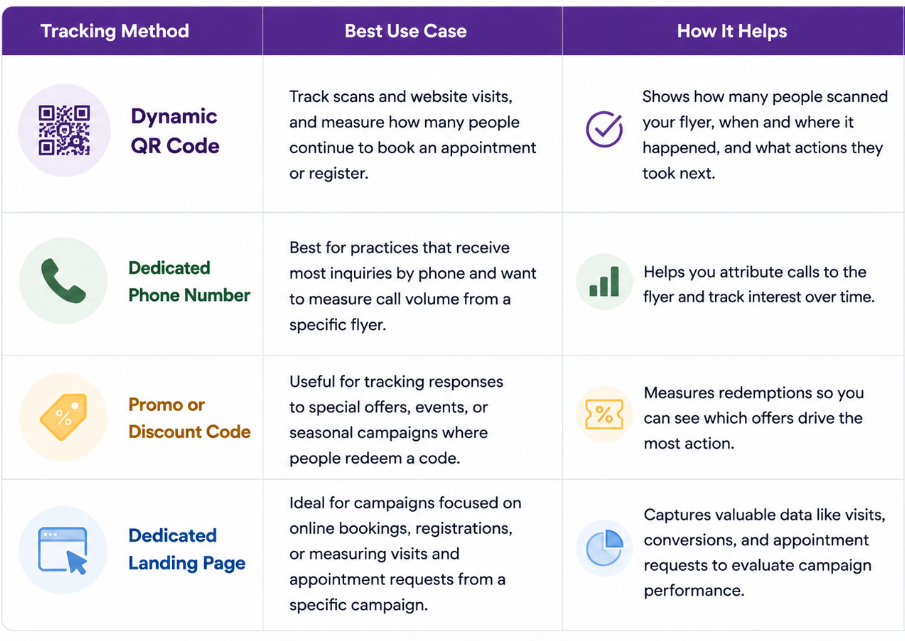
There's no single "best" tracking method, the right choice depends on how you expect people to respond. For most clinics and wellness organizations, a QR code linked to a dedicated landing page offers the simplest way to measure performance while making it easy for patients to take the next step.
Templates vs. Custom Design: Which should clinics choose
Templates are a practical choice when speed and simplicity matter most. If you're creating an employee wellness reminder, announcing an internal event, or sharing logistical details like dates and enrollment information, a well-designed template is usually enough. Since the audience already knows and trusts your organization, the priority is communicating information clearly rather than standing out.
Custom design becomes more valuable when your flyer needs to persuade rather than inform. Whether you're promoting a new wellness initiative, introducing a service, or encouraging people to take action for the first time, tailoring the visuals and messaging to a specific audience helps the flyer feel more relevant and memorable. If your team doesn't have in-house design resources, working with a professional design partner can also help ensure your flyer aligns with your brand and campaign goals.
The best choice depends on your objective. Use templates when speed and efficiency matter most, and invest in custom design when your goal is to build awareness, increase participation, or encourage action. And if creating a polished, on-brand flyer feels like more than your team can take on, partnering with a specialized design service like Bespire can help you achieve those goals without starting from scratch.
FAQ
What should a wellness flyer include?
A successful wellness flyer should focus on one clear objective rather than trying to communicate everything at once. At a minimum, include a compelling headline, a specific offer or event, one clear call-to-action, contact or booking information, and a trust signal such as credentials, testimonials (with permission), or professional affiliations. Keep the design simple so readers can quickly understand what you're offering and how to respond.
Are free wellness flyer templates worth using?
Yes, free templates are a great starting point, especially for internal communications or time-sensitive announcements. However, the template itself won't determine whether your flyer succeeds. Customizing the messaging, visuals, and call-to-action to match your audience is what makes the biggest difference in engagement and response rates.
What size should a wellness flyer be?
Standard US letter (8.5" x 11") for print distribution in offices, community boards, and health fairs. Digital-only flyers can use a square or vertical format optimized for social sharing instead.
How do I make a corporate wellness flyer different from a patient-facing one?
Corporate and employee flyers can assume existing trust and skip straight to logistics — dates, enrollment steps, and program details. Patient-facing flyers need to earn trust first, since the reader has no existing relationship with the practice.
Do wellness flyers need HIPAA-compliant language?
Flyers themselves aren't typically covered by HIPAA in the way patient records are, but any language referencing specific patients, testimonials, or outcomes should still go through your practice's compliance review before distribution.
Where should I distribute a wellness flyer for the best results?
Locations where someone is already thinking about health: waiting rooms, pharmacies, community centers, and health fairs outperform general public spaces for response rate.