




Five Designers, Five Versions of Your Brand: Why Consistency Breaks When You Add Hands
It is usually the blue that gives it away. An asset comes back and the brand blue is half a tone off - not wrong enough to reject, not right enough to let go. The next one has the logo sitting a little tight to the edge. The one after that is set in a weight your brand does not actually own, by someone who found the closest match on their machine. Each is defensible in isolation. Put all five side by side and you are looking at inconsistent branding, produced by five people who each followed your guidelines.
That last part is what makes this worth writing about. Drift does not usually come from people ignoring the rules. It comes from people reading the same rules and arriving somewhere slightly different, which is a fundamentally different problem and has a fundamentally different fix.
What drift actually looks like up close
Take one campaign through five pairs of hands and the pattern repeats with unnerving reliability.
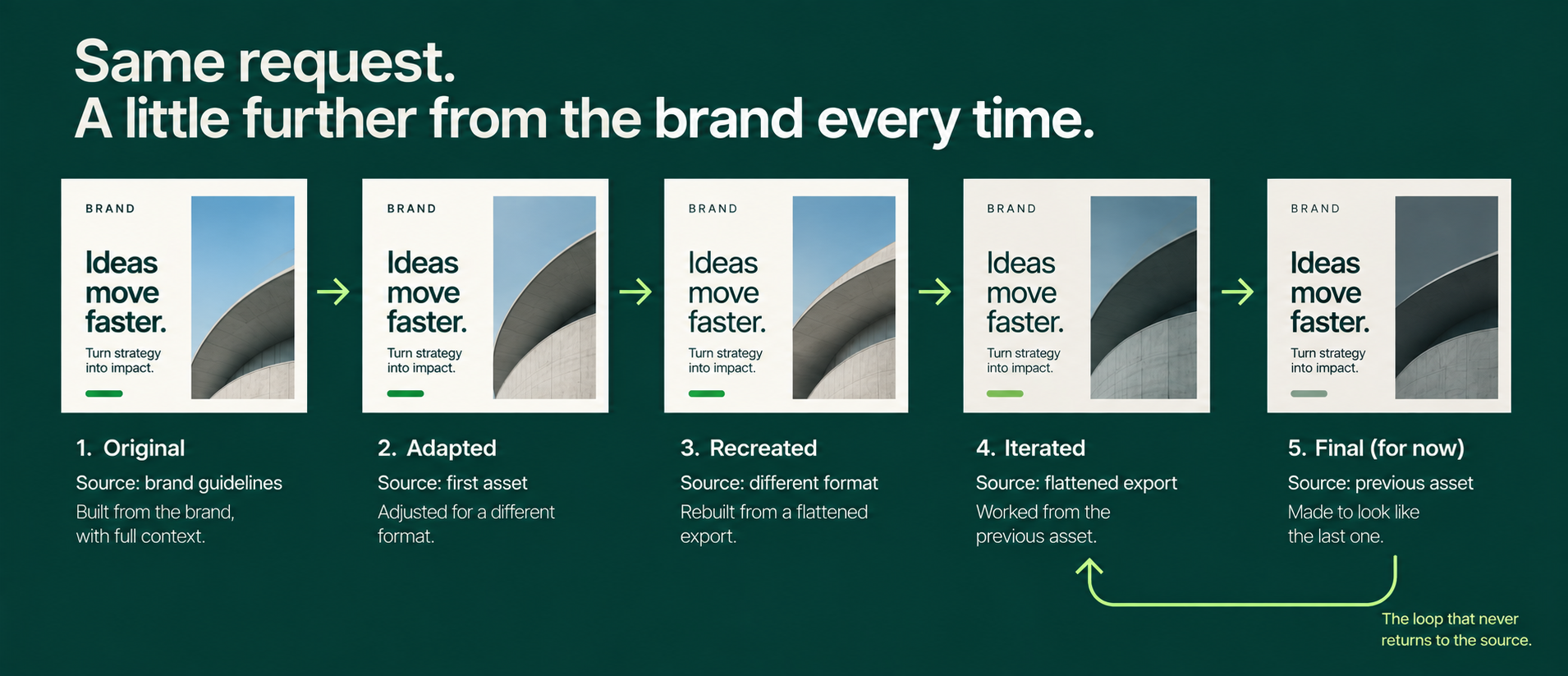
The first designer built the original and made forty small decisions that were never written down - how much air sits above the headline, which of the three approved greys is the real secondary, what happens to the logo when the photograph behind it is busy. The second designer adapted it for a different format, hit a situation the guidelines do not cover, and resolved it sensibly. The third had the original as a flattened export, so the type is a visual match rather than the actual typeface. The fourth worked from the third. The fifth was told to make it look like the last one.
By the fifth asset, nobody is working from the brand. They are working from an interpretation of an interpretation.
This is why the damage is so hard to argue about internally. There is no asset you can point to as the failure. Each one passes inspection on its own, and the drift only exists in aggregate - which means it usually surfaces in a quarterly review, months of production too late, as a vague feeling that the brand looks tired.
It is worth being precise about what goes missing at each step, because it is not talent and it is not care. It is context. The second designer did not know what the first had decided, or why. Nothing in the chain carried the reasoning forward - only the output. Drift is what happens when context resets with every request.
Why guidelines cannot prevent inconsistent branding
A brand guideline is a description. It tells you what the brand is when the brand is behaving normally - the palette, the type scale, the logo and its clear space, a page of photographic direction, some do-and-do-not examples.
Almost no real asset is a normal situation.
Real work is a story format when the guidelines were drawn for desktop. A busy photograph with nowhere clean to place the logo. A headline three words too long for the type scale. A partner logo that has to sit next to yours at some defensible relative size. A price badge nobody anticipated. A regional market needing a longer legal line. Every one of these is an edge case, and every asset you ship is made of them.
Guidelines do not decide edge cases. People do. A document cannot arbitrate between two reasonable readings of itself, and asking it to is the mistake sitting underneath most brand governance programmes.
Which is also why asset libraries do not solve this. Storing approved files well is genuinely useful, but it addresses retrieval, not interpretation - and the interesting evidence here comes from the storage vendors themselves. Bynder's 2026 State of DAM research, reported in Forbes in July, found 93% of businesses face content challenges that traditional rule-based automation cannot currently solve, with detecting off-brand content at scale named among the most common. That is the category conceding its own limit. The same research put three-quarters of content as already AI-touched, which adds hands faster than any library can add rules.
It is worth noticing what the rest of the literature leans on. Nearly every article written about brand consistency cites the same figure - that consistent presentation can raise revenue by up to 33%. It comes from a Lucidpress survey published in December 2019, self-reported by just over two hundred organizations, and it superseded a 23% version of itself from 2016. Seven years later it is still being repeated as though it settled something. A category recycling one dated vendor statistic is a category that has not looked closely at the problem.
Mechanism 1: interpretation needs an owner
The first thing that stops drift is unglamorous: someone accountable for deciding what the brand does in situations the guidelines never described, whose decisions carry across everyone producing work.
What that looks like structurally varies. In a company with an in-house team it is usually a Creative Director or a brand lead - someone with enough standing to settle a question and have it stay settled. The title matters much less than the two things the role has to supply: judgement about situations the document did not cover, and continuity, so that the answer given in March is still the answer in September.
The work itself is narrower and more concrete than any job title suggests. It is deciding that the display face is never used below a certain size, so nobody has to guess. Deciding which grey is the secondary and retiring the other two. Deciding what happens to the logo over a busy image - a defined scrim, not a judgement call. Deciding whether the illustration style extends to iconography or stops at spot illustration. Deciding how much white space is our amount of white space, in a number rather than a feeling.
Each of those is a decision a guideline document is not capable of making, and one that five designers will otherwise make five times, differently, forever.
The accountability matters as much as the judgement. When interpretation is distributed, no decision is ever final - the question comes back on the next brief, gets answered by whoever is nearest, and the answer changes.
Ownership on its own is not sufficient either, because people are not durable storage. A decision that lives only in somebody's head is one handover, one holiday or one busy fortnight away from being made again from scratch. What makes interpretation actually hold is the pairing: someone accountable for the call, and somewhere that call stays visible to whoever picks up the brand next. In our own workflow that responsibility does not sit with a single director figure above the work - it sits with the Success Manager who stays close to the account, working alongside the designer, with the brand's accumulated history behind them. More on that below.
Mechanism 2: a system of parts, not a bigger document
The instinct when drift appears is to extend the guidelines. More pages, more examples, more edge cases anticipated. This almost never works, because you cannot enumerate faster than reality produces new situations, and because a hundred-page PDF is read by nobody in a hurry.
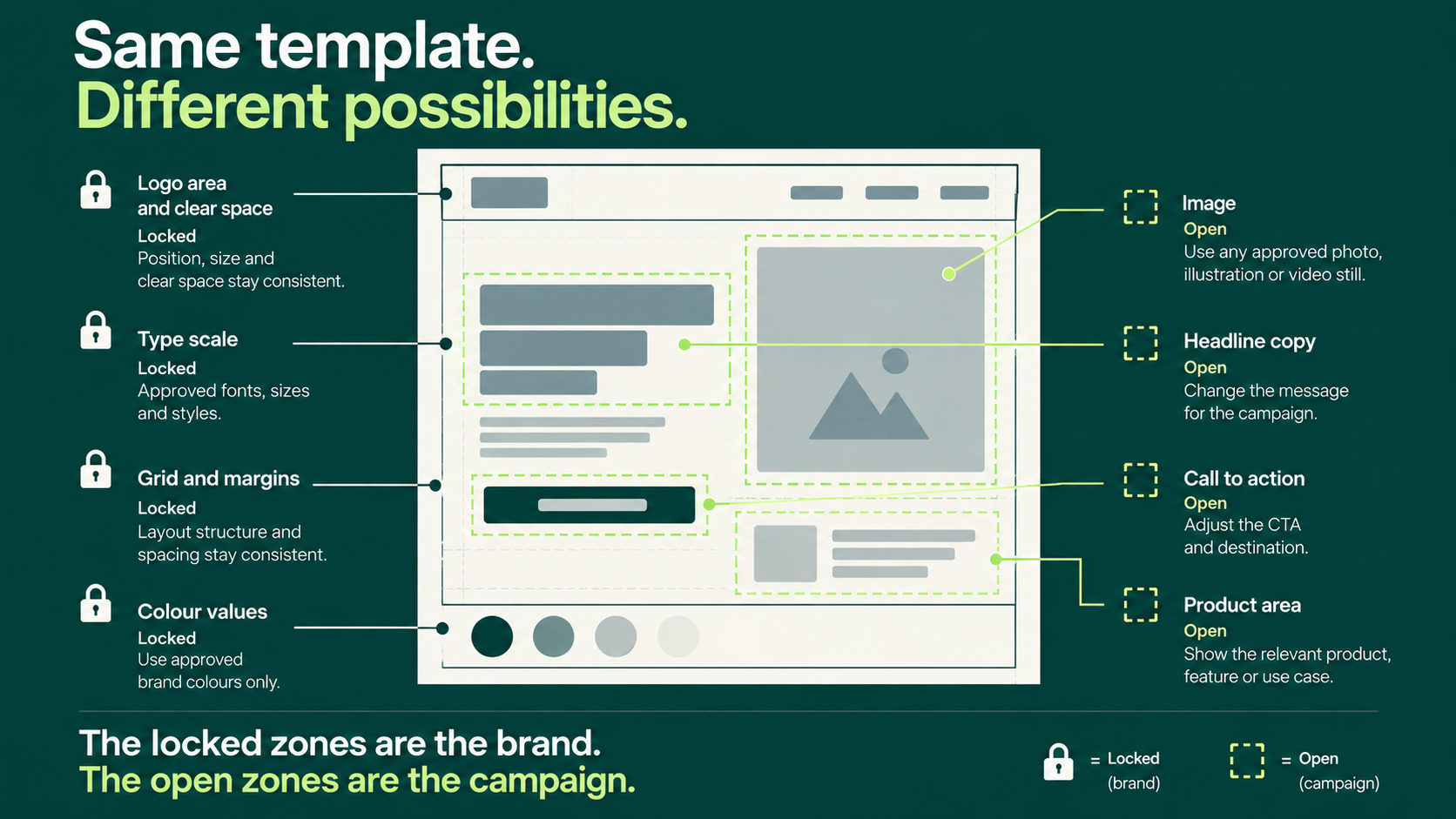
What works instead is converting the description into reusable parts. Built templates for the formats you actually produce, components for the elements that recur, and - the piece teams most often miss - an explicit distinction between what is locked and what is open.
Locked means the type scale, the logo placement and clear space, the colour values, the grid and margins. Not up for interpretation, not adjustable to fit a long headline. Open means the image, the headline copy, the call to action, the product shown. A designer working inside a system like that cannot drift by accident, because the elements that carry the brand are not the elements they are moving.
This also reframes what you are asking a new freelancer to do. Interpreting a brand from a PDF is a hard, high-variance task that takes weeks to get right. Producing work inside a defined system is a much smaller task, and a competent designer does it well on day one.
Mechanism 3: review against a standard, not against taste
Most creative review is preference wearing a lanyard. I am not sure about the green. Can we try it bigger. I liked the other one. None of that tells a designer what to change, and none of it protects the brand - a designer can satisfy every comment in that list and still ship something off-brand.
Reviewing against a standard means checking specific, checkable things, and separating that check from the conversation about whether the work is any good. Both conversations are legitimate. Running them together is what makes review rounds expensive and inconclusive.
Ten checks cover most real drift:
|
The check |
What it catches |
|---|---|
|
Logo clear space and minimum size |
Lockups squeezed to fit, logos crowded against an edge, marks scaled below legibility in small formats. |
|
Colour by value, not by eye |
Everyone's own version of the brand blue. Screen values used for print, and half-tone shifts introduced by resaving through different tools. |
|
Type from the defined set |
A weight the brand does not own, or a visual lookalike substituted because the real file was not available to whoever built the asset. |
|
Type scale applied, not adjusted |
Sizes nudged to accommodate copy that is too long - the single most common cause of assets that feel almost right. |
|
Grid and margins honoured |
Assets that look subtly off with no identifiable single error. Usually this is the margin. |
|
Image treatment and crop rules |
Photography that contradicts the brand's direction, inconsistent crops, filters applied by preference. |
|
Hierarchy matches the message |
Everything emphasised, or the actual offer smaller than the decoration around it. |
|
Locked zones untouched |
A component that was meant to be fixed, edited to solve a layout problem. |
|
Format and channel specs correct |
The right idea at the wrong aspect ratio, or artwork that violates the platform's safe area. |
|
Source file present and named |
The next adaptation starting from a flattened export, which is where generation loss begins. |
None of these require taste. Any organized person can run them, which is the point - a standard that depends on the reviewer's eye is not a standard, it is another interpretation.
Where this sits in how we work
This is the part of creative operations we spend the most time on, because brand drift is the failure mode that shows up whenever work is spread across more than a couple of people.
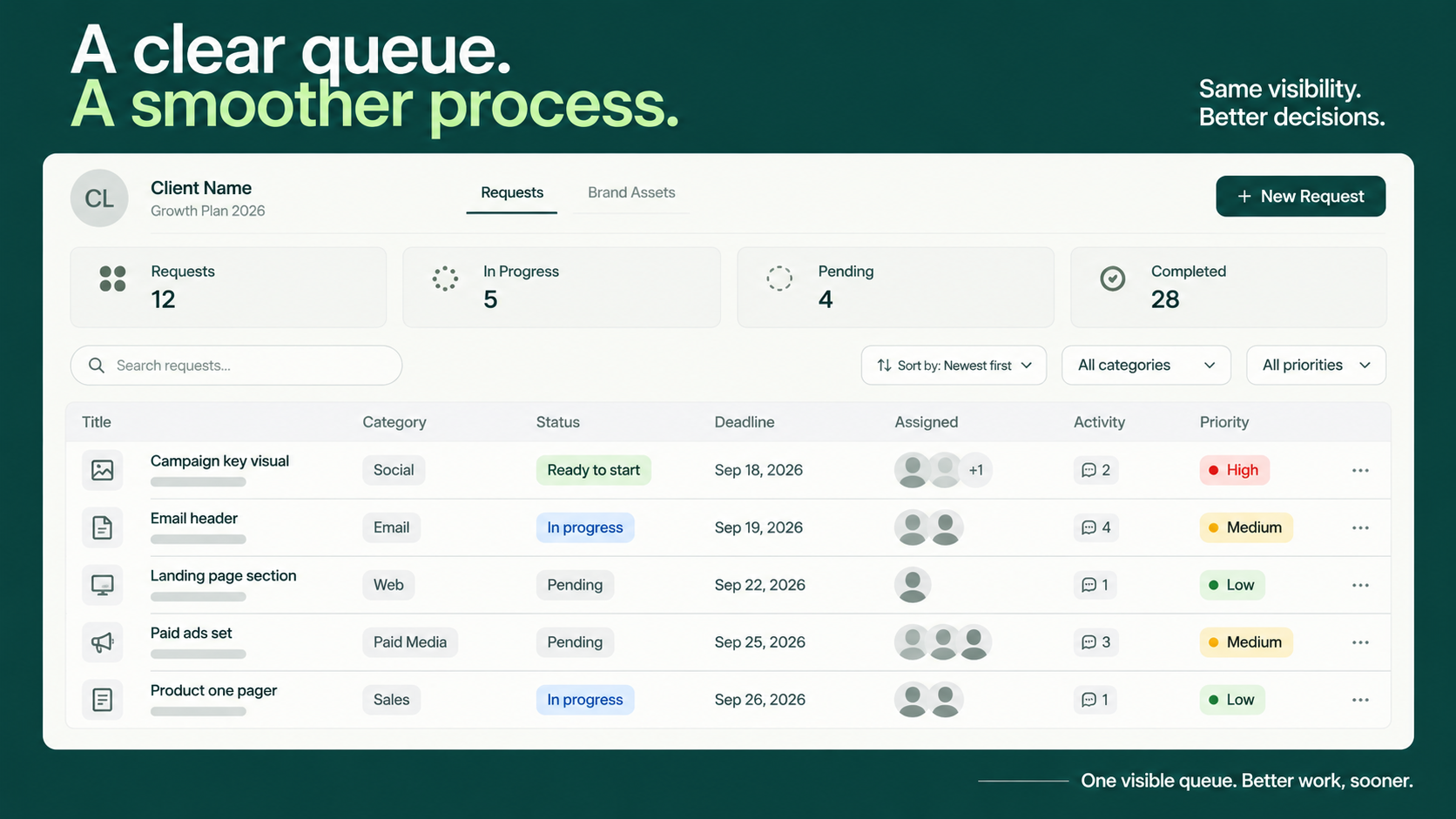
In our workflow the accountable interpreter is not a separate director figure sitting above the work. A Success Manager stays with the account over time. They make each request ready before it reaches production - the missing asset, the unconfirmed copy, the format nobody specified, the deadline that turns out to mean review rather than launch - and then work alongside the assigned designer rather than handing the request over and stepping away. Because they have seen the brand's previous requests, they can tell a designer how the brand has already been applied in practice, which is a more useful thing to know than what the guidelines say it should be.
The designer is not working from the guidelines alone either. Opening the next request, they can see the previously approved assets for that brand, the earlier versions behind them, the source files, the feedback that changed them and the decisions that were settled last time. One thing we try hard to avoid is a designer having to rediscover a decision the previous designer already made.
The client can see the same history. Previous work and versions are not sitting in one person's folder, one email thread or one team member's memory - which matters most at exactly the moments continuity usually breaks. Somebody leaves. Somebody is away. A new freelancer joins in the middle of a campaign.
This is the other half of the generation-loss problem, and the half that gets far less attention. The chain earlier in this article degrades because each person inherits less than the person before them; by the fifth asset, all that survived was a flattened export. When the working history travels with the work, the fifth designer is not looking at the fourth designer's interpretation. They are looking at the source files, the versions, the feedback and the approved direction that produced it. Context accumulates instead of resetting.
None of that removes the need for judgement. Somebody still has to decide what the brand does in a situation nobody anticipated. What it changes is how often that decision has to be made: once, rather than every time the work changes hands.
We see this most clearly at the start of an account, in the assets a new client arrives with - which are usually a record of every time context went missing.
What we tend to establish in the first weeks of an account is less a fixed set of rules and more a shared reference point for how the brand should behave.
Sometimes a client arrives with an established brand book and a library of previous work. Other times, the identity is still fairly open, and part of the work is building that visual language with them as new formats and needs appear. The inconsistencies we see at the start are often practical ones: different typography across assets, product lines that feel like they belong to different brands, or AI-generated visuals that started from the same reference but gradually changed in style from one output to the next.
We do not necessarily respond by declaring that one approved design is now the permanent rule. Instead, the account builds context over time. When a new request comes in, the Success Manager and designer can look back at previous requests, approved pieces, client comments, the brand book and, importantly, the editable files behind earlier work. If a client asks for a second version of something produced a month ago, the next designer does not have to rebuild it from a flattened export or guess how it was made. The working file and the decisions around it are still there.
That history becomes part of how the brand gets refined. An approved piece can become a reference for what comes next, but the system stays flexible enough to evolve with the client as they clarify what they want.
Worth being straight about the limits. If you have one designer and modest volume, you do not have this problem yet and should not buy a solution to it - drift needs hands. If you have a strong internal brand lead whose judgement everyone already defers to, you have the ownership half of mechanism one; what you probably need is mechanism two, and somewhere for those decisions to live once they are made. This matters most when work is spread across freelancers, agencies or a rotating cast, and nobody owns the edge cases or remembers how the last one was settled.
The checklist, and what to do this week
We have put the ten checks together as a one-page brand check, formatted to sit next to a reviewer while they work. It is deliberately not a brand governance programme. It is the smallest thing that catches most drift, and it is useful whether or not you ever speak to us.
If you want one move before the download, make it this: find the last five assets your brand shipped, put them on one screen, and look at them as a set rather than one at a time. Whatever you notice in the first ten seconds is the thing to codify first.
Frequently asked questions
What causes inconsistent branding?
Most often, several people interpreting the same brand guidelines differently rather than anyone ignoring them. Guidelines describe a brand in normal conditions, but real assets are full of situations the document never covered - odd formats, long headlines, busy photography, partner logos. Each person resolves those reasonably and slightly differently, and the differences accumulate across assets.
Will brand guidelines fix brand consistency?
Only partly. Guidelines establish the fixed elements, which is necessary but not sufficient, because they cannot arbitrate edge cases and every asset contains them. Consistency holds when someone is accountable for interpreting the brand, the recurring parts exist as reusable templates and components, and work is reviewed against checkable criteria instead of personal preference.
How do you keep multiple designers on brand?
Give them a system rather than a document, and give them the brand's working history. Built templates for the formats you actually produce, components for recurring elements, and an explicit split between locked zones (type scale, colour, logo placement, grid) and open zones (image, copy, call to action). Then make sure the next person can see the previous approved assets, the source files and the feedback that shaped them, so they are not reinterpreting the brand from zero each time.
Does a DAM solve brand consistency?
A digital asset management system solves retrieval - finding the current approved file instead of recreating it - which is real value. It does not solve interpretation, and the sector's own research says so: Bynder's 2026 State of DAM found 93% of businesses face content challenges that rule-based automation cannot currently solve, including detecting off-brand content at scale. Storage and interpretation are different problems.
What is brand governance, in practical terms?
Deciding who interprets the brand, what is fixed versus flexible, and how work gets checked before it ships. In large organizations that becomes a formal programme with dedicated roles and tooling. For most mid-market teams the working version is one accountable interpreter, a template system, a short review standard applied consistently, and somewhere the decisions already made stay visible.
How often should brand templates be updated?
When reality outruns them, not on a schedule. The practical trigger is noticing the same edge case resolved ad hoc more than twice - a format that keeps appearing, a headline length that never fits, a placement people keep improvising. That is a template gap, and closing it is faster than correcting the same drift repeatedly.
Consistency is an operations outcome
The reason brand drift resists brand solutions is that it is not really a brand problem. Nothing is wrong with the identity. What is missing is a decision about who interprets it, a system that makes the right thing the easy thing, a check that does not rely on anybody's eye, and somewhere for all of that to live so it survives the next handover.
Download the one-page brand check and run it against your last five assets. If the answer is uncomfortable and you are producing at a volume where it will keep happening, that is worth a conversation. The part that does not fit on a checklist is continuity - a Success Manager who knows how your brand has actually been applied, working with designers who can see the history behind every request. See how the Bespire workflow runs, or just take the checklist. Both are fine outcomes.