




For decades, we've treated creativity like a delivery order.
You placed a request for a campaign, waited for it to be prepared, received the final files, and considered the job done.
But today's marketing pace has made that way of working obsolete.
Brands no longer live off isolated launches, they now exist in a constant conversation with their audience. Social media updates, paid ads, landing pages, campaign adaptations, product iterations. Content is no longer occasional – it is continuous.
To scale content production and maintain relevance, brands must overcome the traditional creative bottlenecks that slow execution.
This is exactly where a subscription design service, also known as Creative as a Service (CaaS) or a creative subscription model, becomes essential. It transforms unpredictable creative costs into a predictable operational investment.
In this new landscape, creativity can no longer be something that only shows up when there's a deadline. It must function as infrastructure.
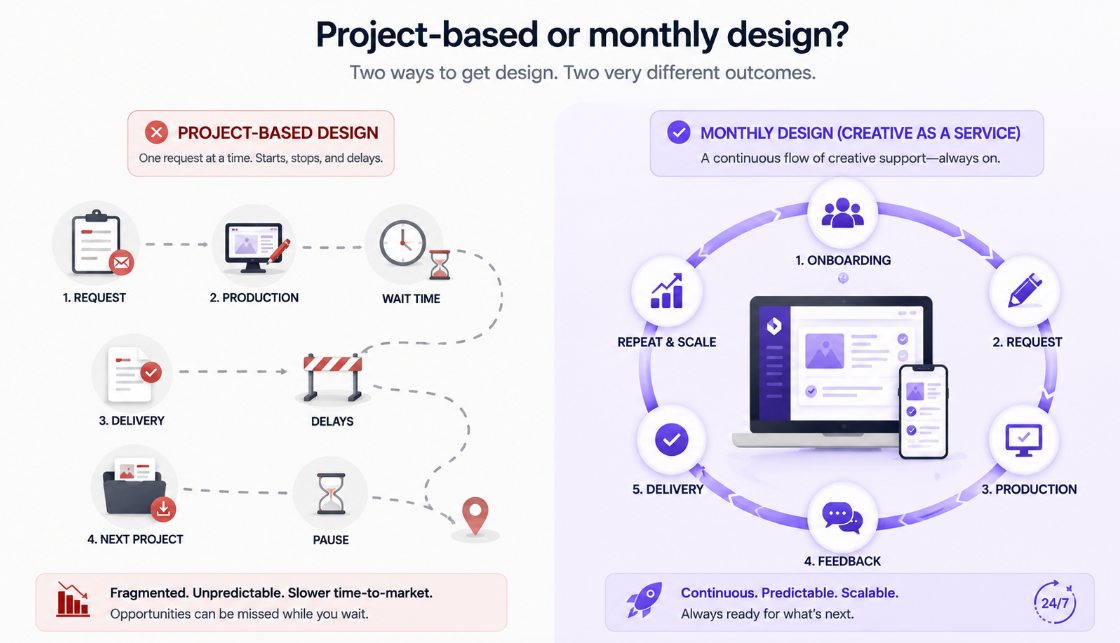
Why project-based design can hold your brand back
The core problem with the traditional project-based design model is not the quality of the final output. It’s everything that gets lost in between.
Every time you initiate an isolated project, your brand has to re-introduce itself. That means re-explaining:
-
What your brand does
-
How it communicates
-
What it prioritizes
-
What it wants to achieve
-
What tone and visual direction it follows
That “re-explanation phase” is invisible, but expensive.
When creative support is continuous, under a subscription or Creative as a Service model, the dynamic shifts entirely:
-
The team already understands your brand and its communication style
-
No one starts from scratch with each deliverable
-
Work builds on what's already been created, not on documents
-
Production flows faster and requires far less rework
The Time-to-Market problem in traditional agency models
To put this into perspective:
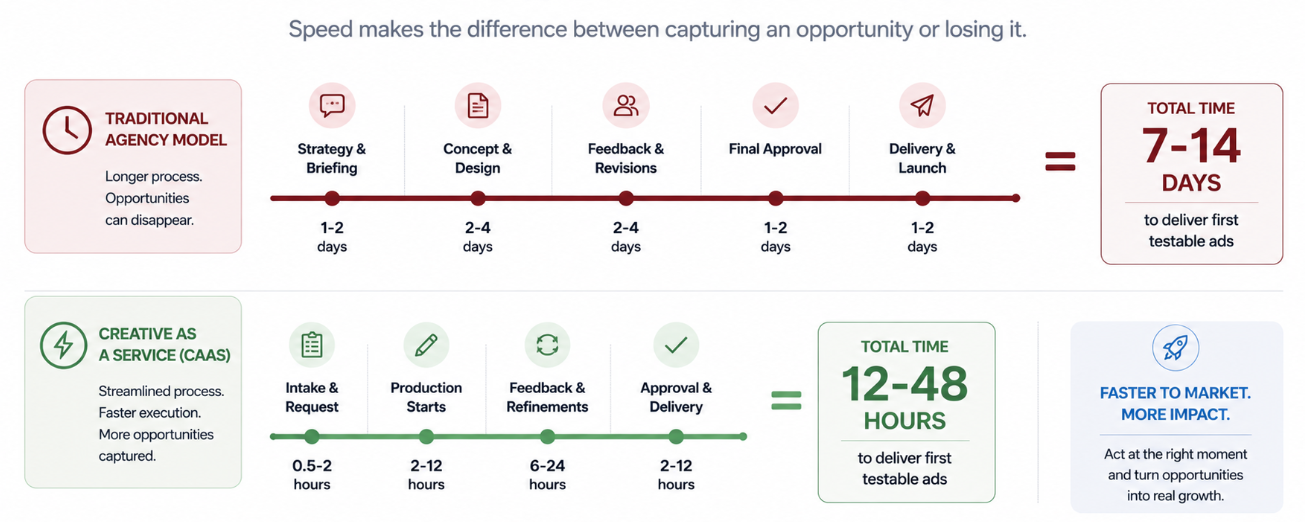
The traditional agency model typically takes between 7 and 14 business days just to deliver the first testable ads.
Between strategy sessions, briefing rounds, concept approvals, and revisions, a trending opportunity can disappear before the asset is even live.
In fast-moving markets (especially in eCommerce and B2B SaaS) delays don’t just slow execution. They cost revenue.
And that’s where the real difference between project-based design vs Creative as a Service becomes clear.
The real cost of creative delays
A delay in a redesign can cause a retailer to lose revenue during key sales events, like Black Friday, equivalent to or greater than the total cost of the project itself.
In high-growth sectors like B2B SaaS, eliminating this 're-explanation phase' has helped teams reduce production time by 43%.
What previously required weeks of back-and-forth coordination can now be resolved within 12 to 48 hours through structured on-demand creative services.
This is not just about speed. It is about timing.
Acting at the right moment in the market can drive revenue growth by up to 127%, transforming design from a reactive operational expense into an engine for immediate growth.
These results are not coincidence.
They are the outcome of managing creativity as a continuous system, not as a sequence of isolated projects.
That is the foundation of Creative as a Service (CaaS).
What is Creative as a Service (CaaS)?
Continuous creative support, also known as Creative as a Service (CaaS) is not simply 'design on demand' or a bundle of visual deliverables. It's a different way of operating creativity within a company: as an active, scalable, and always-available capability.
Platforms like Bespire have popularized this model, enabling brands to stop hiring vendors for one-off tasks and instead rely on a creative system that integrates seamlessly into their daily workflow.
In essence, CaaS transforms creativity into operational infrastructure that never stops.
The pillars of Creative as a Service model
This model rests on three key pillars:
-
Access to specialized talent: multidisciplinary teams (design, video, copywriting, UX) that are already vetted and ready to work, no hiring process, no structural costs of an in-house team.
-
Centralized operations: tools and processes that organize briefs, feedback, and deliverables in one place, eliminating the fragmentation typical of scattered emails, chats, and files.
-
Adaptable capacity: the ability to scale creative output up or down based on campaigns, launches, or seasonal peaks, without the need to hire or halt operations.
In essence, CaaS turns creativity into operational infrastructure: something that doesn't switch on only when a project arrives, but stays running to support brand execution and growth at all times.
How Creative as a Service works in practice
Understanding how this model operates day-to-day is key to grasping its real impact because it's not just a design service, it's an operating system for creativity.
It runs on a subscription-based flow that transforms content production into a predictable, scalable routine. Global platforms have standardized this process, removing the typical friction of creative management and dramatically accelerating time-to-market.
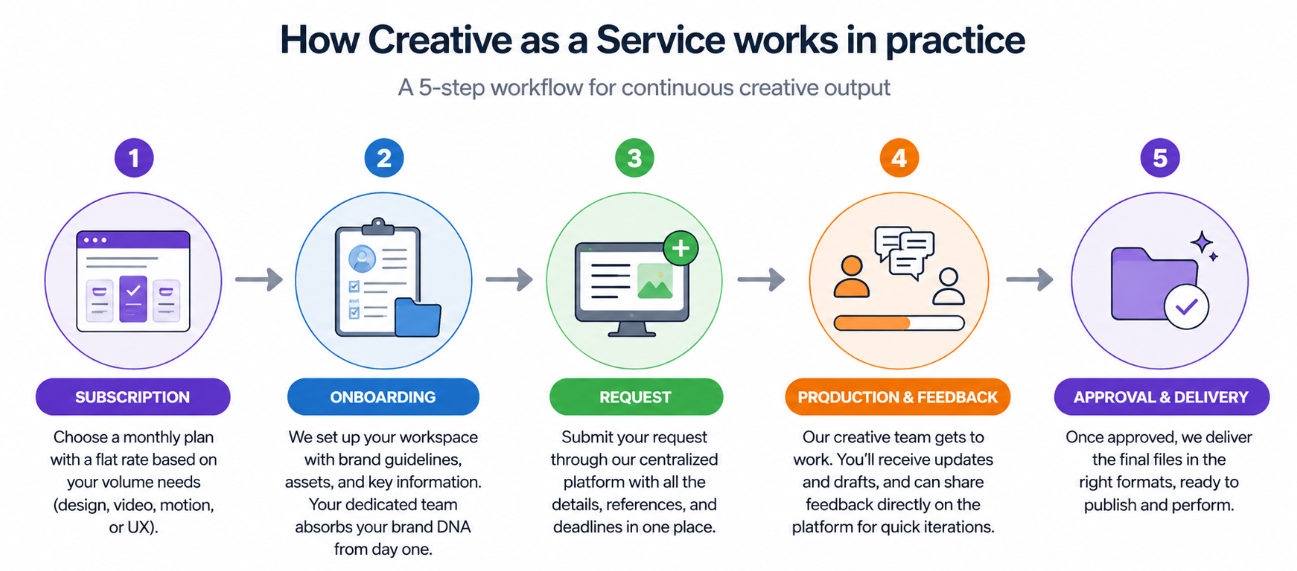
Here's what the day-to-day experience looks Step-by-step:
-
Smart subscription: Choose a monthly plan with a flat rate based on your volume needs (design, video, motion, or UX).
-
Onboarding and brand centralization: After subscribing, a workspace is set up with your brand guidelines, typography, and key assets. A dedicated team, usually led by a Creative Project Manager, absorbs your visual DNA from day one, so you never have to explain 'who you are' with each new request.
-
Simplified request system: Forget email chains. Requests are managed through a centralized platform where you upload the brief, context, and objectives. The system automatically assigns the most suitable creative profile for each specific task, ensuring technical quality.
-
Production and real-time feedback: Initial drafts are typically delivered within a 12 to 48-hour window. Review happens through live collaboration tools (such as direct comments on the design), enabling agile, precise adjustments with no additional cost.
-
Approval and delivery: Once approved, the system delivers final files in ready-to-use and editable formats. The cycle closes at a speed that allows marketing teams to react to trends while they're still relevant.
In practice, it looks like this:
Imagine you need to launch a landing page for a campaign starting this week. Instead of searching for a designer, coordinating schedules, and building from scratch:
-
You upload the brief
-
The creative team works within your existing visual style
-
You receive a proposal within hours
-
You make adjustments, approve, and publish
But speed is only part of the equation. The true value of continuous creative support isn't in how many assets are produced, it's in what happens when all those assets start building on the same foundation.
How continuous creative support optimizes your daily marketing
When creative work is managed through isolated projects, marketing loses continuity.
Each campaign feels like a reset, channels feel disconnected, and the brand message weakens over time.
Continuous creative support ensures daily execution builds on the same foundation.
It aligns:
-
Tone
-
Visual narrative
-
Production logic
-
Strategic direction
Studies show that 79% of companies experience stronger brand recognition when visual identity remains consistent over time.
How this translates into real results:
-
Stronger brand recognition: audiences identify the communicator faster.
-
Less rework: the team doesn't have to redefine styles or guidelines with every new asset.
-
Better cross-channel experience: web, ads, and social media feel like part of the same ecosystem.
-
More agile production: every new asset is built on an already-defined foundation.
Consistency stops being a stylistic choice and becomes an operational advantage, allowing marketing to move with rhythm, coherence, and continuity, without unnecessary friction at every new execution.
Traditional project-based design vs. Design on demand
Choosing between models depends on your business's growth pace. However, for marketing teams that need speed without sacrificing visual coherence, the differences are decisive.
|
Feature |
Traditional Project Model |
Creative as a Service (Bespire) |
|
Turnaround Time |
7 to 15 business days. |
12 to 48 hours. |
|
Learning Curve |
High: you have to re-explain your brand every time. |
Minimal: the team already knows your brand DNA. |
|
Management & Feedback |
Scattered across emails and chats. |
Centralized in a single platform. |
|
Costs |
Variable and hard to budget. |
Predictable flat monthly rate. |
|
Scalability |
Slow. |
Immediate and on-demand |
While the traditional model is designed for isolated milestones, Creative as a Service is designed for constant momentum.
Why brands are moving toward creative systems, not isolated projects
In an environment where content, trends, and opportunities emerge and disappear within hours, the most agile brands are no longer looking for one-off vendors, they're building permanent creative systems.
The future is not in isolated projects. It is in scalable creative infrastructures that:
-
Maintain brand coherence
-
Accelerate time-to-market
-
Convert creativity into competitive advantage
If your brand operates in constant motion, shifting toward a Creative as a Service model is not stylistic, it's a strategic decision to grow faster, with less friction.
FAQs
What's the difference between project-based design and monthly design?
Project-based design works well for specific needs: a campaign, a rebrand, a one-time launch.
Monthly or subscription-based design is built for day-to-day needs: ongoing content, adaptations, recurring assets, and brand evolution.
Does Creative as a Service replace an in-house design team?
Not necessarily.
Creative as a Service (CaaS) is not designed to replace internal teams. It operates as an extension, absorbing workload that the internal team cannot handle alone.
It protects strategy while accelerating execution.